
________________________________________________________________
MALAYSIA PLANS TO HAVE THE 2ND BIOMASS REFINERY IN THE WORLD IN 2016. It will be in Johore.
…
WHAT IS BIOMASS?
Biomass is biological material derived from living, or recently living organisms. It most often refers to plants or plant-derived materials
As a renewable energy source, biomass can either be used directly via combustion to produce heat, or indirectly after converting it to various forms of biofuel. Conversion of biomass to biofuel can be achieved by different methods which are broadly classified into: thermal, chemical, and biochemical methods.
http://en.wikipedia.org/wiki/Biomass
WHAT IS A BIOMASS REFINERY?
A biorefinery is a facility that integrates biomass conversion processes and equipment to produce fuels, power, and chemicals from biomass.
http://www.nrel.gov/biomass/biorefinery.html
—
Environment News Service
World’s First Refinery Turning Farm Waste to Bioethanol Opens
Posted by News Editor in Energy, Latest News, RSS on October 14, 2013 11:12 am
CRESCENTINO, Italy, October 14, 2013 (ENS) – The world’s first commercial-scale refinery to produce bioethanol from agricultural residues and energy crops has opened in northern Italy. When fully implemented, the system will provide 75 million liters of bioethanol annually for the European market.
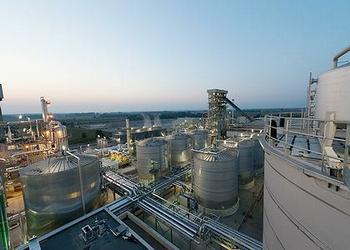
Beta Renewables new cullulosic ethanol plant in northern Italy (Photo courtesy Novozymes)
http://ens-newswire.com/2013/10/14/worlds-first-refinery-turning-farm-waste-to-bioethanol-opens/
—
The Sun daily
World’s second biomass refinery by end of 2016
Last updated on 4 November 2013 – 11:05pm
KUALA LUMPUR (Nov 4, 2013): Malaysia will have the world’s second biomass refinery to convert biomass waste into usable products by the end of 2016.
Work to build the multi-million ringgit facility in Johor is expected to begin at the end of next year. Currently, the only biomass refinery in the world is in Italy.
The Johor plant will be developed by MYBiomass Sdn Bhd, a special-purpose vehicle formed under the Malaysian Industry-Government Group for High Technology (MIGHT), in collaboration with Sime Darby Bhd and Felda Global Ventures Bhd.
This was revealed at the High Level Forum On Biodiversity and Development Post-2015, which was launched by Prime Minister Datuk Seri Najib Abdul Razak here today.
The plant is among Malaysia’s efforts to be in line with the Sustainable Development Goals (SDGs) and the United Nations Millennium Development Goals (MDG) agreed by nations in 2000.
…
Might President and chief executive officer Yusoff Sulaiman told a press conference that the plant is set to generate potential returns of an estimated RM100 billion by 2025.
“This refinery will start off with a focus on oil palm biomass where there are converted into industrial sugar and one of the very high value green chemical called Isobutanol,” he said.
Meanwhile MYBiomass chief executive officer R. Puvaneswari said the company is currently in the planning stage of building the plant and expects to have the ground breaking in the fourth quarter of next year.
“We have about 80 million of biomass, but we are only targeting 20% of the total biomass available. We are hoping to start operations by end-2016,” she said.
World’s second biomass refinery by end of 2016
—

What Is a Biorefinery?
A biorefinery is a facility that integrates biomass conversion processes and equipment to produce fuels, power, and chemicals from biomass. The biorefinery concept is analogous to today’s petroleum refineries, which produce multiple fuels and products from petroleum. Industrial biorefineries have been identified as the most promising route to the creation of a new domestic biobased industry.
By producing multiple products, a biorefinery can take advantage of the differences in biomass components and intermediates and maximize the value derived from the biomass feedstock. A biorefinery might, for example, produce one or several low-volume, but high-value, chemical products and a low-value, but high-volume liquid transportation fuel, while generating electricity and process heat for its own use and perhaps enough for sale of electricity. The high-value products enhance profitability, the high-volume fuel helps meet national energy needs, and the power production reduces costs and avoids greenhouse-gas emissions.
Conceptual Biorefinery
NREL’s biorefinery concept is built on two different “platforms” to promote different product slates. The “sugar platform” is based on biochemical conversion processes and focuses on the fermentation of sugars extracted from biomass feedstocks. The “syngas platform” is based on thermochemical conversion processes and focuses on the gasification of biomass feedstocks and by-products from conversion processes.
 For more, click on:
http://www.nrel.gov/biomass/biorefinery.html
—————————————————————————————————
 weehingthong