
..
..
Face masks
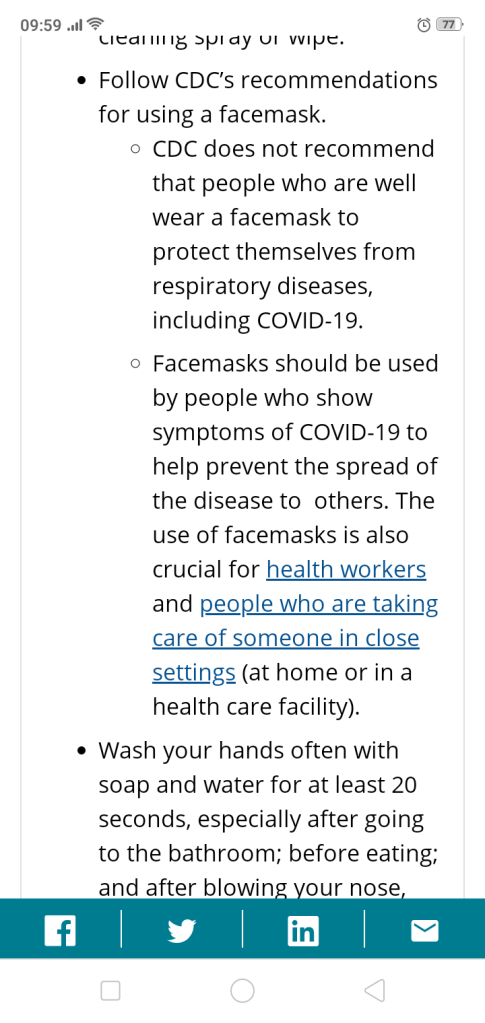
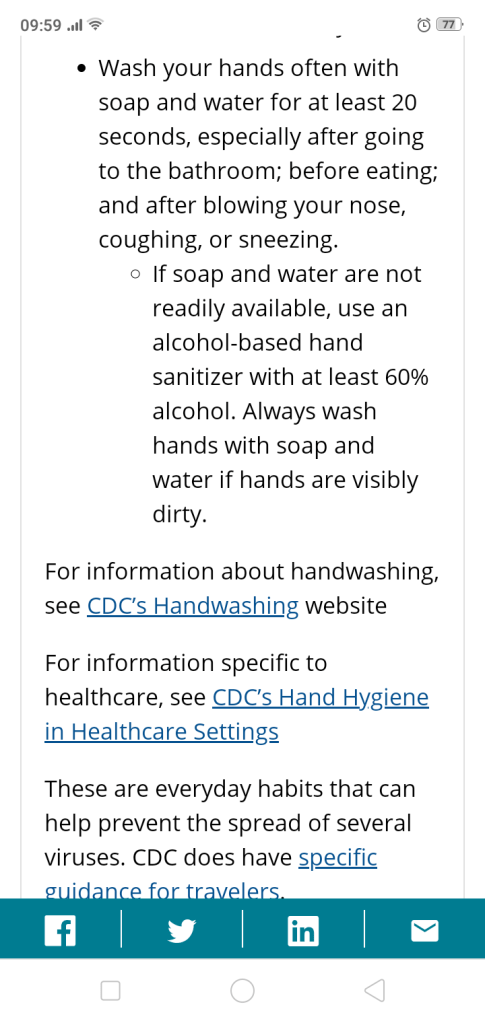
Alcohol kills viruses, so use a sanitizer with at least 60% alcohol.
..
..
..
..
Panic buying is contagious!
..

Pengerusi UDA positif Covid-19
..
Khazanah Nasional Berhad today confirmed that one of its employees has come down with Covid-19 and efforts are underway to trace the employee’s close contact.
Khazanah did not provide details but sources told Malaysiakini the employee in question is Case 26, one of four new cases announced by the Health Ministry today.
The sources said the employee is a senior member of the Khazanah leadership.
Sources also told Malaysiakini that Khazanah’s office at Mercu UEM, KL Sentral has been sealed and is now undergoing sanitisation.
Khazanah, in a statement today, said it is coordinating with health authorities on the matter.
“Khazanah is working closely with the health authorities and the management of our office premises in undertaking the necessary measures and precautions to ensure the health and safety of all our employees and those around them.
..
..
..
..
This is based on 83,000 cases OUTSIDE the US.
..
..
..

PARIS: As the number of confirmed coronavirus cases across 61 countries hit 86,000 Saturday with nearly 3,000 deaths to date, the profile of those most at risk of dying is coming into focus, experts told AFP.
But the overall mortality rate remains uncertain, they said.
The World Health Organization raised its global risk assessment to its top level Friday, with the global health crisis edging closer to a pandemic.
Among those infected with the virus, older adults with pre-existing heart conditions or hypertension face a sharply higher risk, according to preliminary statistics, including from a study covering more than 72,000 patients in China.
Among a subset of 44,700 infections confirmed through lab tests as of mid-February, more than 80% were at least 60 years old, with half over 70, said the study, that was published in the official China CDC Weekly.
Initial reports from outside China are similar, with the first 12 victims reported in Italy mostly in their 80s, and none under 60. Several had known heart problems.
Men in the China study were more likely to die than women by a margin of almost 3-to-2.
But whether that was due to behaviour – notably that most men in China smoke, while few women do – or biological factors, such as hormonal differences, is still unknown.
One striking finding from the China study is the near absence of cases among children.
The 10-19 age bracket comprised 1% of infections, and a single death.
Children under 10 made up less than 1%, with no deaths reported.
“We are still trying to wrap our heads around the deficit of cases among those under 20,” Cecile Viboud, an epidemiologist at the US National Institute of Health’s Fogarty International Centre, told AFP in an interview.
“Is it because young children are less susceptible than adults, and thus simply don’t get infected? Or if they do, that they have less disease?”
It is surprising infections of very young people are so low, she added, because they tend to be among the hardest hit by almost all respiratory infections – whether viral or bacterial.
.
.
The ratio of confirmed cases to deaths suggests a mortality rate of 3.4%, but several studies have concluded that up to two-thirds of infections in China and elsewhere have gone undetected, which would make the virus far less deadly.
“At the moment, we don’t have a good understanding of the real mortality rate,” Sharon Lewin, director of the Doherty Institute for Infection and Immunity at the University of Melbourne told Australian television.
“It is estimated at about 2%.”
With SARS – which killed nearly one in 10 patients – early mortality figures turned out to be underestimates, in part because victims of the virus did not die quickly.
With the 2009 H1N1 influenza pandemic, however, the opposite happened, said Viboud.
“Within a few weeks of the outbreak, the mortality estimate declined first 10-fold, and then 100-fold, as we moved from severe pneumonia to getting all flu cases.”
“Here, I think we are somewhere in the middle,” she added, saying the current 2% mortality estimate could well decline.
The seasonal flu has an average mortality rate of about 0.1% but is highly infectious, with up to 400,000 people worldwide dying from it each year.
The China CDC study showed that Covid-19 was “mild” for more than 80% of confirmed cases.
..
..

Singapore’s coronavirus response has contained the outbreak—but its strategy is hard to replicate
It’s emerging as a litmus test of whether the deadly pathogen can be, if not contained, then neutralized.
- Philip J. Heijmans and Bloomberg
February 28, 2020 3:02 AM EST
As the novel coronavirus starts to gather speed in Europe, the Middle East and the U.S., there’s one place it is seemingly being contained: Singapore.
With no reported virus-related deaths despite 96 cases, and a slowing rate of infection that’s been outpaced by recoveries, the Asian city-state is emerging as a litmus test of whether the deadly pathogen can be, if not contained, then neutralized.
The answer is maybe, and perhaps only with the unique combination of factors that Singapore brings: a top-notch health system, draconian tracing and containment measures, and a small population that’s largely accepting of government’s expansive orders. Few other countries battling an outbreak that’s now infected more than 83,000 globally and killed over 2,800, can replicate these circumstances.
Singapore’s tally of cases is still inching up but it’s no longer the worst-hit nation outside of China after South Korea saw an over 30-fold increase in a week. Italy, with at least 650 confirmed cases, has now become the epicenter in Europe while Iran has reported an alarming jump in numbers of those infected and dead.
“There seems to be more of a willingness to place the community and society needs over individual liberty and that helps in a public health crisis,” said Kent Sepkowitz, an infectious disease control specialist at Memorial Sloan Kettering Cancer Center in New York.
‘Not Hesitate’
Singapore was aggressive out of the gate and has continued to be. It was one of the first countries to impose restrictions on anyone with recent travel history to China and parts of South Korea. It has a strict hospital and home quarantine regimen for potentially infected patients and is extensively tracing anyone they may have been in contact with.
It’s charging a couple who gave false information on their travel history and taking away residency status from a person who breached his quarantine, among other punitive actions.
Singapore “will not hesitate to take strong action” against rule breakers, Law Minister K. Shanmugam said in a statement Thursday. “The deliberate breaking of the rules, in the current situation, calls for swift and decisive response.”
The country started a text and mobile web-based software solution on Feb. 10 through which people placed under home quarantine could report their location to the government, according to a statement Thursday from the Prime Minister’s Office.
“This served as the first level of verification of compliance for close to 12,000 foreign employees,” the office said in statement.
The consistently forceful posture is in contrast to other Asian nations, who despite being closer geographically to China, have been slower to act. Japan and South Korea are both facing criticism for lax and delayed containment measures that have led to mounting virus cases.
As the epidemic that emerged from China threatens to become a global pandemic that could wipe off $1 trillion from the world’s gross domestic product, Singapore used its early infections to establish an advanced contact tracing system.
It’s now using a new serological test developed by Duke-NUS Medical School that can establish links between infected cases, which will allow authorities to map out the chain of transmission and therefore try to break it. Local researchers had earlier successfully cultured the novel virus within a week of Singapore confirming its first case.
A historically “very strong epidemiological surveillance and contact-tracing capacity” in Singapore led to a high detection rate initially, according to a yet to be peer-reviewed study published by researchers at the Harvard University.
The country’s experience with the 2003 SARS outbreak in which 33 people died in Singapore, and the 2010 swine flu known as H1N1 where an estimated more than 400,000 people were infected, meant that precautions were already in place. These included ready-made government quarantine facilities and a 330-bed, state-of-the-art national center for managing infectious diseases that opened last year.
No Hinterland
To be sure, few other countries can recreate Singapore’s circumstances. It’s a small, rich nation without a hinterland or health-care shortages. It’s been ruled by one political party for its nearly 55 years of independence, and local media outlets carry the government’s messaging without questioning, from washing hands to staying at home if someone is not feeling well.
In a recorded address earlier this month, Prime Minister Lee Hsien Loong reassured Singaporeans that the city had enough supplies and that the virus didn’t appear as deadly as SARS, meaning that most people would likely experience a minor illness even if they contracted it. The population has been noticeably calmer since.
Fresh infections in Singapore may still break out given the virus’s long incubation period and lack of symptoms in some carriers. The country’s chief health scientist, who led the public health response during SARS, has cautioned that more cases can emerge anytime given the rapid increase in global numbers.
Business Hub
Authorities have tested more than 1,300 people, while the Ministry of Health has imposed two-week quarantines on 2,887 close contacts of infected patients. Singapore is also a regional business hub with a large flow of overseas visitors.
After a local business meeting was tied to a cluster that spread to countries in Asia and Europe, officials said earlier this month they were investigating residents who attended the meeting to prepare for the possibility of fresh confirmed cases. Three infected people have recovered and no fresh cases related to this meeting have emerged.
But what Singapore is showing the world is that when all the stars are aligned, the virus may not be as uncontrollable as feared.
The situation “tells you a lot about Singapore’s health care system and their confidence,” said Sepkowitz.
..
https://twitter.com/KittySn52889207/status/1233970642099171329?s=19
..
 weehingthong