
..
Excerpts from:
Scientists and medical researchers have for years have differed over the exact definition of a pandemic (is it a pandemic, or an epidemic), but one thing everyone agrees on is that the word describes the widespread occurrence of disease, in excess of what might normally be expected in a geographical region.
Cholera, bubonic plague, smallpox, and influenza are some of the most brutal killers in human history. And outbreaks of these diseases across international borders, are properly defined as pandemic, especially smallpox, which throughout history, has killed between 300-500 million people in its 12,000 year existence.
A final note: The most recent outbreak of the Ebola virus, which has killed thousands of people, is still confined to West Africa. It may someday be pandemic, but for now, is considered an epidemic — and is therefore not included on this list.
HIV/AIDS PANDEMIC (AT ITS PEAK, 2005-2012)
Death Toll: 36 million
Cause: HIV/AIDS
First identified in Democratic Republic of the Congo in 1976, HIV/AIDS has truly proven itself as a global pandemic, killing more than 36 million people since 1981. Currently there are between 31 and 35 million people living with HIV, the vast majority of those are in Sub-Saharan Africa, where 5% of the population is infected, roughly 21 million people. As awareness has grown, new treatments have been developed that make HIV far more manageable, and many of those infected go on to lead productive lives. Between 2005 and 2012 the annual global deaths from HIV/AIDS dropped from 2.2 million to 1.6 million.
FLU PANDEMIC (1968)
Death Toll: 1 million
Cause: Influenza
A category 2 Flu pandemic sometimes referred to as “the Hong Kong Flu,” the 1968 flu pandemic was caused by the H3N2 strain of the Influenza A virus, a genetic offshoot of the H2N2 subtype. From the first reported case on July 13, 1968 in Hong Kong, it took only 17 days before outbreaks of the virus were reported in Singapore and Vietnam, and within three months had spread to The Philippines, India, Australia, Europe, and the United States. While the 1968 pandemic had a comparatively low mortality rate (.5%) it still resulted in the deaths of more than a million people, including 500,000 residents of Hong Kong, approximately 15% of its population at the time.
ASIAN FLU (1956-1958)
Death Toll: 2 million
Cause: Influenza
Asian Flu was a pandemic outbreak of Influenza A of the H2N2 subtype, that originated in China in 1956 and lasted until 1958. In its two-year spree, Asian Flu traveled from the Chinese province of Guizhou to Singapore, Hong Kong, and the United States. Estimates for the death toll of the Asian Flu vary depending on the source, but the World Health Organization places the final tally at approximately 2 million deaths, 69,800 of those in the US alone.
FLU PANDEMIC (1918)
Death Toll: 20 -50 million
Cause: Influenza
Between 1918 and 1920 a disturbingly deadly outbreak of influenza tore across the globe, infecting over a third of the world’s population and ending the lives of 20 – 50 million people. Of the 500 million people infected in the 1918 pandemic, the mortality rate was estimated at 10% to 20%, with up to 25 million deaths in the first 25 weeks alone. What separated the 1918 flu pandemic from other influenza outbreaks was the victims; where influenza had always previously only killed juveniles and the elderly or already weakened patients, it had begun striking down hardy and completely healthy young adults, while leaving children and those with weaker immune systems still alive.
SIXTH CHOLERA PANDEMIC (1910-1911)
Death Toll: 800,000+
Cause: Cholera
Like its five previous incarnations, the Sixth Cholera Pandemic originated in India where it killed over 800,000, before spreading to the Middle East, North Africa, Eastern Europe and Russia. The Sixth Cholera Pandemic was also the source of the last American outbreak of Cholera (1910–1911). American health authorities, having learned from the past, quickly sought to isolate the infected, and in the end only 11 deaths occurred in the U.S.
FLU PANDEMIC (1889-1890)
Death Toll: 1 million
Cause: Influenza
Originally the “Asiatic Flu” or “Russian Flu” as it was called, this strain was thought to be an outbreak of the Influenza A virus subtype H2N2, though recent discoveries have instead found the cause to be the Influenza A virus subtype H3N8.
THIRD CHOLERA PANDEMIC (1852–1860)
Death Toll: 1 million
Cause: Cholera
Generally considered the most deadly of the seven cholera pandemics, the third major outbreak of Cholera in the 19th century lasted from 1852 to 1860.
THE BLACK DEATH (1346-1353)
Death Toll: 75 – 200 million
Cause: Bubonic Plague
From 1346 to 1353 an outbreak of the Plague ravaged Europe, Africa, and Asia, with an estimated death toll between 75 and 200 million people.
PLAGUE OF JUSTINIAN (541-542)
Death Toll: 25 million
Cause: Bubonic Plague
Thought to have killed perhaps half the population of Europe, the Plague of Justinian was an outbreak of the bubonic plague that afflicted the Byzantine Empire and Mediterranean port cities, killing up to 25 million people in its year long reign of terror.
ANTONINE PLAGUE (165 AD)
Death Toll: 5 million
Cause: Unknown
Also known as the Plague of Galen, the Antonine Plague was an ancient pandemic that affected Asia Minor, Egypt, Greece, and Italy and is thought to have been either Smallpox or Measles, though the true cause is still unknown. This unknown disease was brought back to Rome by soldiers returning from Mesopotamia around 165AD; unknowingly, they had spread a disease which would end up killing over 5 million people and decimating the Roman army.
Sources:
http://news.discovery.com/human/health/10-worst-epidemics-130917.html
http://www.cbc.ca/news/technology/cholera-s-seven-pandemics-1.758504
http://www.ncbi.nlm.nih.gov/pmc/articles/PMC3867475/
http://content.time.com/time/specials/packages/completelist/0,29569,2027479,00.
htmlhttp://www.infoplease.com/cig/dangerous-diseases-epidemics/bubonic-plague.html
http://www.who.int/csr/resources/publications/surveillance/plague.pdf
http://healthvermont.gov/prevent/Plague.aspx
http://www.historylearningsite.co.uk/black_death_of_1348_to_1350.html
http://www.loyno.edu/~history/journal/1996-7/Smith.html
http://www.nytimes.com/2010/11/01/health/01plague.html?_r=0
http://news.bbc.co.uk/2/hi/health/4381924.stm
http://www.loyno.edu/~history/journal/1996-7/Smith.html
http://www.infoplease.com/cig/dangerous-diseases-epidemics/smallpox-12000-years-terror.html
http://www.who.int/mediacentre/factsheets/fs360/en/index.html
http://www.avert.org/worldstats.htm
http://www.cdc.gov/hiv/statistics/basics/
http://www.history.com/topics/1918-flu-pandemic
http://www.infoplease.com/cig/dangerous-diseases-epidemics/smallpox-12000-years-terror.html
http://www.who.int/bulletin/volumes/89/7/11-088815/en/
https://www.mphonline.org/worst-pandemics-in-history/
..
..
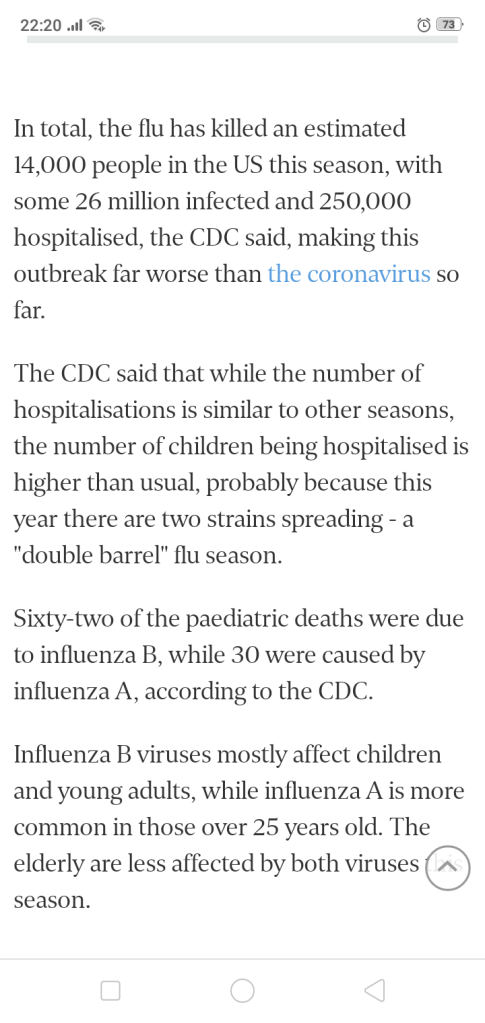
Flu continues its march…
Flu has claimed 14,000 lives so far this season.

..
Flu Cases Surpass 22 Million as 13th Coronavirus Case is Confirmed in US
FEB 11, 2020 | MICHAELA FLEMING With cases of the novel coronavirus (COVID-19) increasing across the globe, why should we be paying attention to influenza—a respiratory illness that is seen year after year?
The answer lies in the numbers.
Currently, there have been 13 confirmed cases of the COVID-19 in the United States, yet flu cases for the 2019-20 US season have topped 22 million. This is an increase of 4 million cases over the span of 1 week.
The last 3 weeks of surveillance indicate that flu activity continues to increase and is expected to continue for weeks to come.
The US Centers for Disease Control and Prevention’s (CDC) FluView reports that last week the percentage of deaths attributed to pneumonia and influenza stands at 7.1%, just below the epidemic threshold of 7.2%.
Visits to clinicians for influenza-like illness increased from 6.0% to 6.7% last week with all regions remaining above baseline. However, overall hospitalization rates for the season are similar to previous seasons with a current rate of 35.5 per 100,000.
The percentage of respiratory specimens testing positive for influenza at clinical laboratories also increased last week, rising from 28.4% to 29.8%. At this time, 47 jurisdictions are experiencing high influenza-like illness activity, compared with 44 jurisdictions the previous week.
Recent estimates indicate that of the 22 million flu cases in the US thus far, 210,000 hospitalizations have occurred, and 12,000 deaths have been reported. In total, there have been 78 pediatric deaths so far this season, with 10 new deaths reported last week.
Earlier this season it was reported that influenza B/Victoria was the predominant strain for the 2019-20 season, yet at this time cases of the A(H1N1)pdm09 virus are approximately equal to the B strain after rising over recent weeks
Officials with the CDC continue to recommend vaccination as the best way to prevent influenza and reduce duration of illness. According to the agency, approximately 173.3 million doses of the flu vaccine have been administered in the United States this season.
“I think something that gets lost in the narrative is that while the flu shot prevents a percentage of infections, and some people will go and develop the flu anyway, even if they do, there’s some evidence that it’s attenuated, and that the complications from having the flu including death are lessened even if someone develops flu after they’ve gotten a shot,” Jason C. Gallagher, PharmD, editor in chief of Contagion®, and a clinical professor at Temple University of College of Pharmacy, said in a previous interview.
Just last week the CDC announced that experts in the influenza division of the agency have developed a portable flu laboratory that can sequence the influenza genome and analyze influenza A viruses in real-time and on-site in the event of an outbreak.
The kit, which is called Mia (Mobile Influenza Analysis), brings influenza sequencing into the field, which will cut the time needed to genetically analyze flu viruses in half and produce real-time actionable data that can be used in a public health response.
In an animal model study, a team was able to successfully use Mia to extract, sequence, and analyze flu samples in just 14.5 hours, a task that usually takes a week when samples must be sent to a laboratory for examination.
According to the CDC’s statement, the experts who developed the tool estimate that in the event of a flu pandemic, through proactive surveillance and using Mia, there would be an 8-week advantage for flu vaccine manufacturing.
Contagion® will continue to monitor influenza cases and the 2019-nCoV outbreak. To track the case counts in the COVID-19 outbreak, visit the Contagion® Outbreak Monitor.
..
Covid-19 has overtaken SARS…
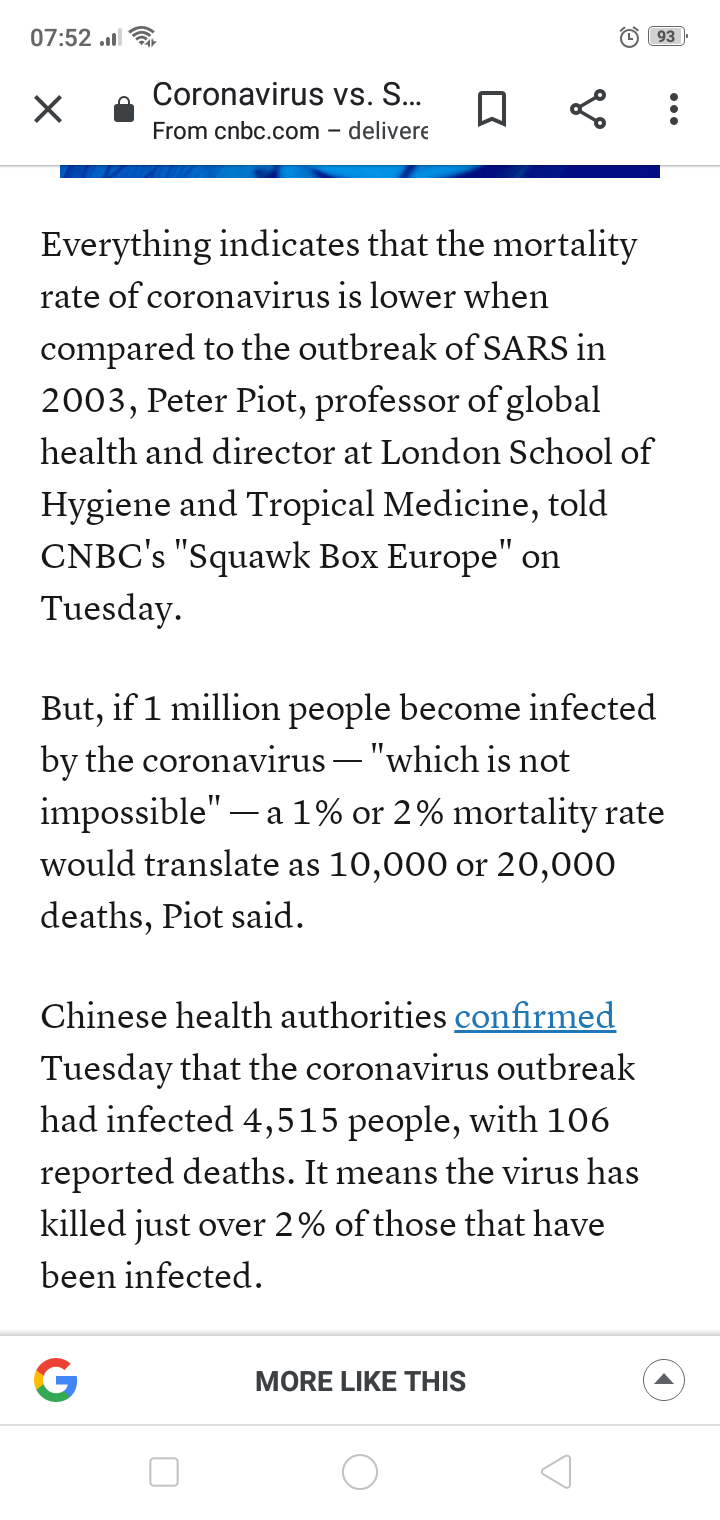
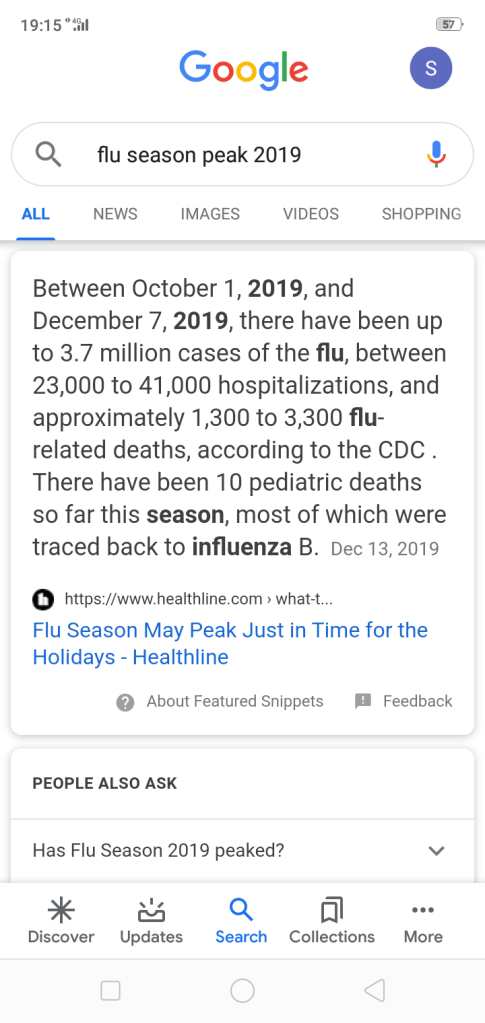
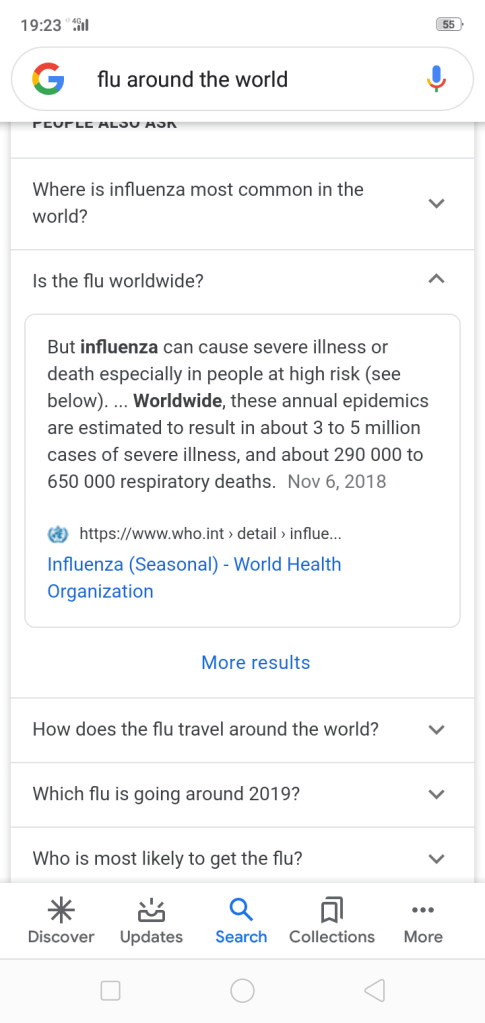
The potency of influenza is largely overlooked because it is always around.


 weehingthong