
..
2017
theSun@theSundaily
Women Family and Community Development Deputy Minister Datuk Azizah Mohd Dun: “…it seems most of the baby found are Malays.”
“We do not know how the police come to the result but this is the information that we get.”
Most baby dumping cases involve Malays, Dewan Rakyat told
07 NOV 2017 / 17:33 H.
KUALA LUMPUR: There are more baby dumping cases involving the Malays than the other races, Women Family and Community Development Deputy Minister Datuk Azizah Mohd Dun (pix) told the Dewan Rakyat today.
Azizah said a total of 174 baby dumping cases were reported since 2016 until June this year.
She added Selangor topped the list as the state with the most baby dumping cases reported in 2016 with 23 cases, followed by Johor and Kuala Lumpur.
“It is hard to identify the race when it comes to baby dumping case. In most cases, the parents of the babies are not known. But based on what has been provided by the police to us, it seems most of the baby found are Malays.
“We do not know how the police come to the result but this is the information that we get,” she said. during the question time.
She was responding to an additional question from Che Rosli Che Mat (PAS-Hulu Langat) who asked whether baby dumping cases mostly involved Malays.
..
..
Johor has highest number of baby-dumping cases nationwide
Published 6 months agoUpdated 6 months ago
Johor exco Liow Cai Tung has expressed concern over the state recording the highest number of baby dumping cases in the country this year.
Citing figures obtained from the police and Johor Welfare Department, Liow said in a statement today that there have been 13 baby-dumping cases in the state as of July.
Of these, Johor Bahru recorded the highest number, followed by Batu Pahat and Kulai, she added.
The figure does not include babies found dead, as these figures are not reported to the Welfare Department.
“Johor takes a serious view of the statistics which show the highest number of baby-dumping cases occurred in this state.
“Awareness programmes on social issues must continue as these efforts will reduce the number of baby dumping cases.
“Youths must be given accurate information to curb this problem, as all efforts begin with education,” said the state exco for tourism, women, family and community development.
Liow (photo) added that state programmes – such as the Diriku Permata Berharga (Dermaga) programme by the Darul Takzim Family Development Foundation (YPKDT) – are aimed at educating communities on the importance of reproductive health and the implications of premarital sex.
Johor allocated RM100,000 in its 2019 budget for the programme to be conducted in 12 schools, she added.
“Besides this, the Generasi Ku Sayang programme, established in Johor in 2014 to help teenagers pregnant out of wedlock to avoid incidents of mother and child deaths, have had 109 trainees… between the ages 16 to 20 years.
“There are seven trainees at GKS centres in the state this year.”
Liow urged teenagers facing a similar predicament to call the 24-hour Talian Kasih (15999) of the welfare department for help.
“Abandoning the baby is not the solution. Instead, it will only endanger the baby’s life and could result in its death,” she added.
Women, Family and Community Development Minister Dr Wan Azizah Wan Ismail revealed last month that seven out of 10 newborn babies found abandoned in Malaysia ended up dead.
Citing police statistics, Wan Azizah called for urgency in dealing with the matter.
She said that unwanted and teenage pregnancies were among the causes of baby-dumping.
Bernama reported earlier this year that 18,000 teenagers get pregnant each year in the country, an average of 50 a day nationwide.
https://m.malaysiakini.com/news/486614
..
Address root causes of baby dumpingPublished on: Sunday, November 03, 2019

IN Malaysia, where baby dumping occurs once every three days, the government seems set on addressing the crisis.
From 2010 to May 2019, 1,010 cases of baby dumping have been recorded. Out of those, 64pc of the babies were found dead, and the majority of the others died shortly after they were rescued.
Recently, a cleaner found a newborn girl in a plastic bag while she was sorting rubbish. The baby’s umbilical cord was still attached to her belly button, there was no heartbeat, she was cold.
It is hard to grasp this sickening trend of living human beings, filled with potential, discarded like trash. How have we arrived here? And does (Women, Family and Com-munity Development Minister Datuk Seri) Dr Wan Azizah Wan Ismail’s campaign aimed at addressing the problem go far enough?
So far, according to the news report, the ministry’s campaign has provided a number of ways to curb this toxic reality, including “locality mapping” and “strategic intervention” in areas that have become hot spots for baby dumping. Also, women with unplanned pregnancies can contact the ministry’s “Talian Kasih” hotline, and awareness posters have been put up in male and female toilet cubicles in rest areas nationwide.
There is no doubt that this is a start, but it seems more like a Band-Aid on a bullet wound than an attempt to get to the root of the problem. Problems like the shame put on women who get pregnant out of wedlock, the taboo of premarital sex, the difficulty of getting access to contraception, and, of course, the poor quality of sex education among young Malaysians.
First, there are legal amendments that must be implemented. The majority of baby dumping cases are a result of unwanted teenage pregnancies. Research shows that 18, 000 teenage girls get pregnant in Malaysia each year, and the vast majority of the pregnancies are unplanned.
All of a sudden, these women find themselves in a totally punitive environment where they can be persecuted under various laws, including religious laws. Abortion is not an option since it is heavily regulated and allowed only in “life or death” cases (however, I’ve heard that many doctors will still refuse to perform abortions on religious grounds).
These pregnant women are left feeling like lepers, unsure about where to go for help and who they can confide in. They are stuck between the devil and the deep blue sea, between raising an unplanned child with no support, or having an illegal and unsafe abortion that could cause serious health complications in the future.
Then there is the problem of our attitude towards sex education. A recent survey reported in another daily showed that one in every three Malaysian men believe sex education will lead to more sexual activity.
This is a microcosm of the larger problem. Without proper education, our youth, especially young women, are incredibly vulnerable. They do not have the knowledge nor the legal ability to obtain contraception if needed, they feel alienated from a community that would rather ignore their “uncomfortable” situation than “get their hands dirty” with education and information, and they are left totally desperate.
Last but certainly not least is the stigmatisation of and discrimination against teenage and unmarried women that fall pregnant. Such attitudes are evident not only in society at large but also within the girls’ own families. A proverb I’ve heard that says “Biar mati anak, jangan mati adat” (Let the child die but not tradition) portrays very well, I feel, the anger and total betrayal felt by parents when they realise their teenage daughter is pregnant. And so, instead of providing support, the family focuses on handling the embarrassment and shame if people find out about the pregnancy.
Just imagine finding yourself in a situation where legally, you are committing a crime, socially, you are a pariah, and physically, you are vulnerable and confused – all while being a teenager trying to find your place in the world. This is the reality for many young women in Malaysia that is, I believe, the leading cause of this increasing trend of baby dumping.
I thank you, Dr Wan Azizah, for beginning the dialogue on this topic, but I urge you, the government and society as whole to push for more. Address the root causes to heal this sickness so that no woman shall feel that dumping a baby is ever a valid option.
JC, Kuala Lumpur
http://www.dailyexpress.com.my/read/3286/address-root-causes-of-baby-dumping/
..
By Azura Abas
June 28, 2019 @ 12:40pm
SEPANG: The government is ramping up its efforts to reduce baby dumping incidents in the country.
Deputy Prime Minister Datuk Seri Dr Wan Azizah Wan Ismail said police recorded 577 cases of baby dumping nationwide between 2014 and 2018.
Dr Wan Azizah, who is also the Women, Family and Community Development Minister, attributed the growing crisis to teenage pregnancy and babies conceived out of wedlock.
“The ministry, together with the police, are in the midst of conducting locality mapping and putting together strategic intervention for areas considered hotspots for baby dumping incidents,” she said after launching the ministry’s anti-baby dumping poster at the Dengkil southbound rest area.
The posters have been mounted on the doors of every toilet cubicle at 22 rest areas along the Plus highway.
Between 1.5 million and 1.6 million people ply the Plus highway daily.
Based on police statistics between January and May this year, Johor recorded 13 baby dumping cases followed by Selangor with 11 cases and Kuala Lumpur with seven cases.
Malaysia is recording an upward trend of baby dumping cases, with 103 incidents recorded in 2014; 111 cases in 2015; 115 cases in 2016; 120 cases in 2017; and 128 cases in 2018.
Dr Wan Azizah urged teenagers and women who need help with their unplanned pregnancies to call the 24-hour Talian Kasih hotline at 15999.
She also reminded them of the seriousness of committing baby dumping, which is investigated under Section 318 of the Penal Code.
It reads: “Whoever, by secretly burying or otherwise disposing of the dead body of a child, whether such child dies before or after or during its birth, intentionally conceals or endeavours to conceal the birth of such child, shall be punished with imprisonment for a term which may extend to two years or with fine or with both.”
Deputy Women, Family and Community Development Minister Hannah Yeoh said main baby dumping sites are housing areas, with 266 cases recorded between 2010 and 2018; followed by public toilets with 108 cases; and rubbish dumps with 89 cases.
“Only 30 per cent of (dumped babies) are found alive,” she added.
Yeoh also urged the corporate sector to join forces with the ministry in its efforts to address baby dumping issues.
“Those who want to give up their babies should consider (handing them over to) appropriate places, such as at Orphan Care facilities and baby hatches placed at KPJ medical facilities,” she said.
KPJ baby hatches are available at KPJ Johor Specialist Hospital, KPJ Damansara Specialist Hospital, KPJ Tawakkal Specialist Hospital, KPJ Seremban Specialist Hospital, KPJ Penang Specialist Hospital, KPJ Ipoh Specialist Hospital, KPJ Perdana Specialist Hospital in Kelantan and KPJ Kuantan Specialist Hospital.
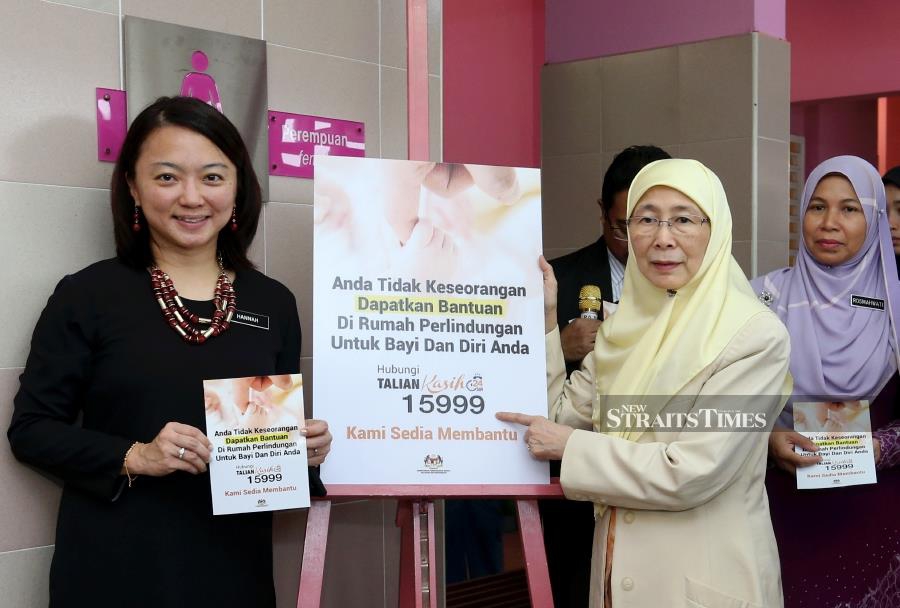
Dr Wan Azizah, who is also the Women, Family and Community Development Minister, attributed the growing crisis to teenage pregnancy and babies conceived out of wedlock. (NSTP/AHMAD IRHAM MOHD NOOR)
..
2012
The Voice of Youngsters on Baby Dumping Issues in Malaysia
Article (PDF Available) · January 2012
AbstractThe increasing cases of outrageous acts of dumping new-born babies and fetuses in Malaysia recently alarming the Malaysian to take serious attention in handling this matter. This research was about youngsters’ perception on baby dumping issue. Out of 7,535 populations at four selected schools at the area of Bakar Arang State Assembly under Sungai Petani Parliamentary, Kedah, 400 students were selected as respondents. In this study, simple random sampling was used. This research used Descriptive Statistic and Pearson Correlation for data analysis purposes. Data were collected from July until October 2010. Three hypotheses were tested and accepted. The result indicates that there were positive relationship between awareness towards consequences of free sex, knowledge on sex education and religious belief towards baby dumping cases. The significant of this study was awareness creation on consequences of having free sex among youngsters as well as parents and school administration and also inclusive of religious bodies/agencies in taking seriously on the impact of this issue towards our social development in global era. Conclusion/Recommendations: The recommendations were made to the parties concerned in this issue in order to find the best solution in curbing this problem.
.
VI. CONCLUSION As a conclusion, awareness towards consequences of free sex, knowledge on sex education and religious belief showed the significant relationships with the baby dumping issues in Malaysia. Most of the respondents agreed that these three variables have a significant impact on baby dumping cases. It is important for the teenagers to understand the consequences of free sex so that they can prevent the unwanted pregnancy at the young age. Besides that, the knowledge on sex education is important to ensure the teenagers have a better understanding about their body so that they will not easily involve in free sex which can lead to the baby dumping. On top of that, the important of religious belief and practices also play a vital function. Every religion has lay down and taught about the dos and don’ts, about the sin and reward, and all religion prohibited the act of free sex. In order to prevent it, the government, schools, parents and teenagers should take necessary actions to stop this baby dumping issue from becoming worse.
 weehingthong