
…
1 September 2018
The wall at the Malaysia-China Kuantan Industrial Park (MCKIP), which has been the subject of controversy was built with the aim of protecting high-value assets and the safety of Alliance Steel (M) Sdn Bhd’s workers.
The project’s deputy commander, Steve Hu, said there was no hidden motive in building the wall, seen by locals as a replica of the Great Wall of China, as it should be regarded as a fence erected to protect a residential home.”We really hope it is not demolished because it is important in launching our 24-hour operation every day.
“It is to protect te property in the factory equipped with machines that run continuously, and which are at times, operated without human supervision,” he told reporters after attending the National Day Celebration at the plant yesterday.
.
He added that the wall was necessary for the safety of workers and in preventing wildlife from entering the factory in view of its proximity to the forest.
– Bernama
https://www.malaysiakini.com/news/441253
…
24 August 2018
Read the article:
http://www.malaysia-chronicle.com/?p=130613
…
MCKIP, a Malaysia-China consortium, is the first industrial park in Malaysia to be jointly developed by both Malaysia and China and to be accorded the “National Industrial Park” Status. Together with its sister park, China-Malaysia Qinzhou Industrial Park (CMQIP), the two parks have been identified by both governments as an “Iconic Project for Bilateral Investment Cooperation” that will drive the development of industrial clusters in both countries.
MCKIPSB is a 51:49 joint venture between a Malaysian consortium and a Chinese consortium. IJM Land holds a 40 percent equity interest in the Malaysian consortium, Kuantan Pahang Holding Sdn Bhd, together with Sime Darby Property (30 percent) and the Pahang State Government (30 percent).
The 49 per cent stake of the Chinese consortium is led by the state-owned conglomerate Guangxi Beibu Gulf International Port Group, with a 95 per cent equity interest. The remaining 5 per cent is held by the Qinzhou Investment Company.
.
MCKIP was officially launched in 2013 by Prime Minister YAB Dato’ Sri Mohd. Najib Tun Haji Abdul Razak and His Excellency Jia Qinlin, Chairman of the Chinese People’s Political Consultative Conference. China has emerged as Malaysia’s largest trading partner over the past five consecutive years. In 2014, total trade between China and Malaysia stood at USD 102 billion. MITI’s target is to grow bilateral trade to USD160 billion by 2017.
…
…
22 February 2018
Excerpts from:

Spotlight: Malaysia-China Kuantan Industrial Park set to bring win-win results
When the steelworks runs into full operation in June this year, it is estimated that more than 4,000 jobs will be created, 70 percent of which will be for Malaysian citizens, said Hu Jiulin, deputy project commander of Alliance Steel Malaysia Sdn. Bhd.
Hu added that they received more than 4,000 job applications via the job fair and noted that as many as 10,000 jobs will be generated once all related factories of Alliance Steel start their business.
For quite some time, Malaysia’s economic weight has been scattered along the west coast of peninsular Malaysia, with little or none heavy industries in the east coast. But expectations are high for MCKIP to become a catalyst to drive economic growth in this area.
Alliance Steel has an annual production capacity of more than 3.5 million tons of steel products. According to Hu, the factory will not only be able to meet the bulk demand of the Malaysian market, but also can accommodate the Southeast Asian market, thanks to a surge in infrastructure development in the region.
.
Aside from Alliance Steel, many other projects in the park are also expected to help transform a spark into the fire that will make a difference. Ma Zhengguo, a managing director of MCKIP, told Xinhua that local Malaysian businesses have been benefited even in the construction phase, thanks to a large proportion of the materials procured locally.
Moreover, Ma said MCKIP’s strong relationship with the Kuantan Port, a strategic shipping port located 10 km away, makes the industrial park an attractive destination for businesses.
Hong Kong’s NewOcean Energy announced its plan to set up an oil refinery and related sea terminal facilities at the Kuantan Port for the export and sale of petroleum products in 2017, underscoring ever increasing investment interest from outside of the Chinese mainland.
In fact, the participation of the Chinese side not only brought in capital and new technologies, but also successful experience.
http://www.xinhuanet.com/english/2018-02/22/c_136990790.htm
…
22 December 2017
…
9 October 2017
malaysiakini.comVerified account @malaysiakini
The mystery behind Kuantan’s ‘Great Wall of China’
(Updated )
SPECIAL REPORT
| The Gebeng Bypass, which links Jabur in Terengganu with Gebeng near Kuantan Port, has always been a mundane drive, with kilometres after kilometres of greenery since it opened in 2006.
But beginning 2013, a section of the highway in Gebeng, a small town 25km north of Kuantan, has seen an explosion of activities, with 1,219 acres of land cleared and large-scale construction in full swing.
A new ramp diverges from the Gebeng Bypass to the cleared land, which is now known as the first phase of the Malaysia-China Kuantan Industrial Park (MCKIP).
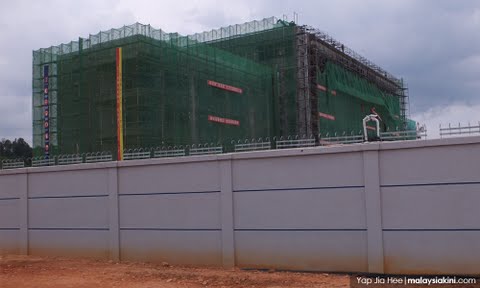
A huge four-storey building under construction sits adjacent to the circular ramp, which is protected by an eight feet tall wall. Satellite images show the wall spanning around the entire project site, with an estimated length of at least nine kilometres.
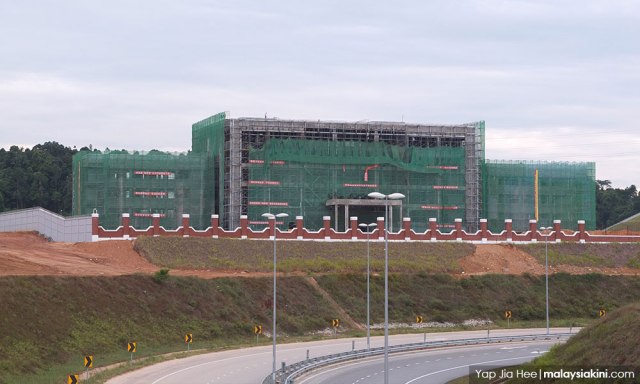
For the local folk, the dull grey wall topped with steel hooks, with the exception of certain sections which are brick red for aesthetic purposes, has come to be referred to as Kuantan’s “Great Wall of China”.
The wall is not exceptional, but its apparent purpose of keeping those inside separate from the outside world has fuelled speculations among the local community.
The regular folk of Kuantan are not allowed within the walls without the approval of the site’s administrator. The small number of locals who are allowed in are those who have business dealings inside.
The main entrance, which is the only entry point for the time being, is strictly manned by guards in white uniforms from a local private security firm, as well as by guards from China, who don black uniforms.
The best glimpse people outside can get of what’s inside are the buildings under construction that tower over the wall, with many Chinese motivational slogans hung over the green safety nets that are typical of construction sites of companies from China.

These observations have given rise to talk among the local community that a China enclave has been carved beyond the wall.
Assemblyperson denied entry
Teruntum assemblyperson Sim Chon Siang had applied to MCKIP to enter the site, in an attempt to dispel the speculations, but he was rejected. Instead, MCKIP sent two representatives to meet Sim outside the industrial park.
.
The city beyond the wall
Describing MCKIP as a “closed city”, Sim said it was nothing like the other industrial parks in greater Kuantan, such as the Gebeng Industrial Park and Semambu Industrial Park, where people are free to enter and the walls or fences are only confined to the individual factories or company buildings.
.
The Pahang government, in a written reply on Sept 14, said during peak periods, a total of 6,000 construction workers were employed at a ratio of three foreign workers to two local workers.
This puts the number at 3,600 foreign workers and 2,400 local workers working on Phase One of the MCKIP. The state government did not specify whether the foreign workers were from China or other countries.
The state government said the composition was necessary to ensure the factories can be completed and commence operations on time for the benefit of the local communiy.
Read the full article:
https://m.malaysiakini.com/news/397677#.WdwI_SMdkVk
…
…
 weehingthong