
…
.
But while Malaysia succeeded in renegotiating the contract to build the East Coast Rail Link, others such as Pakistan and Myanmar, have been less successful.
https://twitter.com/gst183/status/1203263661025808386?s=20
Sri Lanka wants its ‘debt trap’ Hambantota port back. But will China listen?
- Critics view the deal as a symbol of the problems associated with Chinese lending and the Belt and Road Initiative, but Beijing so far shows little sign of changing its mind
- Newly elected President Gotabya Rajapaksa promised on the campaign trail to revisit the agreement, but observers say he will need to offer China something else in return

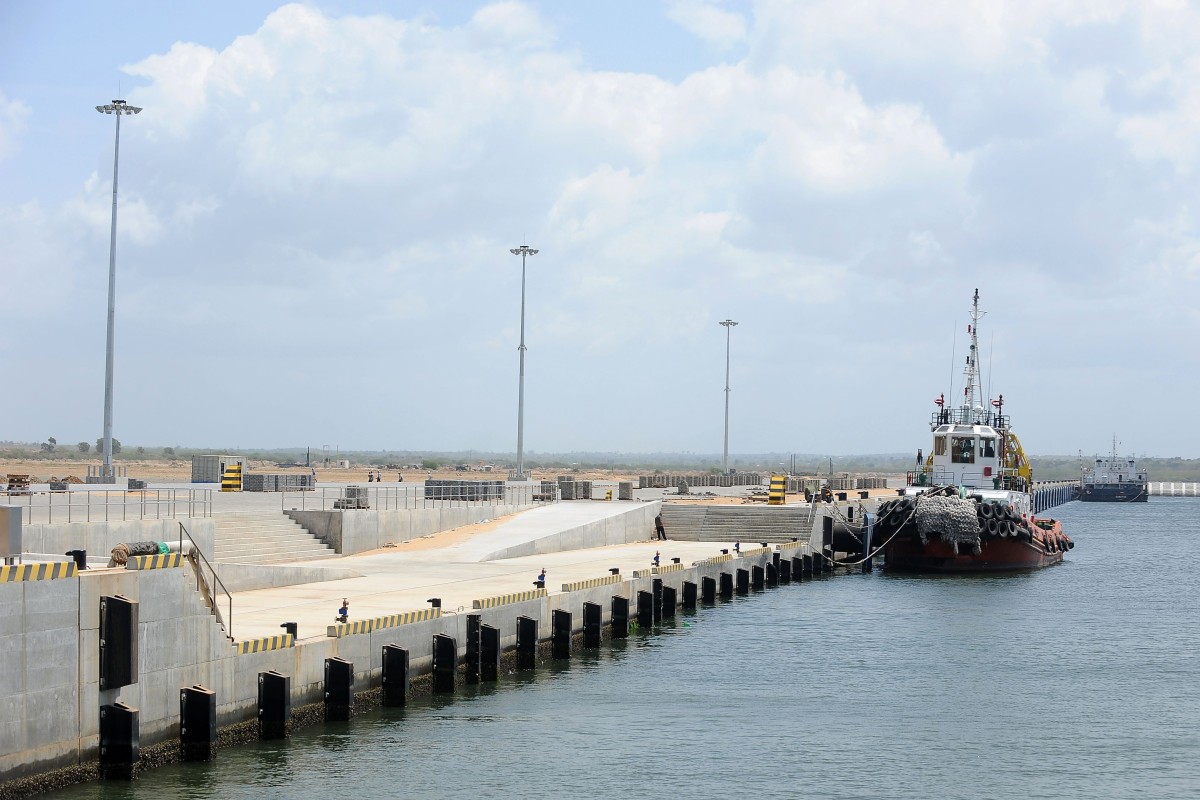
Sri Lanka’s new government wants China to hand back a port it was given two years ago to cover its debts – but its chances of success appear slim.
The port, located at the heart of a busy shipping route in southern Sri Lanka, has been held up by critics as a symbol of the worst aspects of China’s “debt trap diplomacy” with many locals regarding it as a sign of subordination to Beijing.
“The perfect circumstance is a return to the norm,” Ajith Nivard Cabraal, a former central bank governor under Mahinda Rajapaksa, who is now serving as prime minister.
“We pay back the loan in due course in the way that we had originally agreed without any disturbance at all.”
But so far Beijing has given no indication that it will rethink its plans – instead suggesting that development plans for the port should be speeded up.
On Monday, Chinese diplomat Wu Jianghao met Gotabaya Rajapaksa to congratulate him on his election victory – but an account of the meeting by Xinhua indicated that the two countries should “speed up the implementation of cooperation on big economic projects, including the Colombo Port City and the Hambantota Port, under the existing consensus”.
Meanwhile, the president’s office did not go into details about the meeting, only describing it as a “cordial discussion”.
..
18 July 2018
..
“But it’s a trap. Now that it’s been started, the politicians can’t stop it – no matter how harmful it might be. And frankly they don’t want to,” said Grgic, author of a 2017 study on the highway.
Perched atop massive cement pillars that tower above Montenegro’s picturesque Moraca river canyon, scores of Chinese workers are building a state-of-the-art highway through some of the roughest terrain in southern Europe.
The government has described the 165km highway, with its imposing bridges and deep-cut tunnels, as the construction of the century and a pathway to the modern world.
It is designed to link the port of Bar on Montenegro’s Adriatic coast to landlocked neighbour Serbia. But once the first, challenging 41km stretch through mountains north of the capital is completed, the government faces a difficult choice.
A Chinese loan for the first phase has sent Montenegro’s debt soaring and forced the government to raise taxes, partially freeze public sector wages and end a benefit for mothers to get its finances in order.
Despite those measures, Montenegro’s debt is expected to approach 80 percent of gross domestic product (GDP) this year and the International Monetary Fund says the country cannot afford to take on any more debt to finish its ambitious project.
“There is a big question about how they complete it,” said an EU official who requested anonymity. “Their fiscal space has shrunk enormously. They have strangled themselves. And for the time being this is a highway to nowhere.”
The road is at the heart of an intense debate about Chinese influence in Europe, both within EU member states and countries aspiring to join the bloc such as Montenegro and its Western Balkan neighbours Serbia, Macedonia and Albania.
As Beijing extends its economic reach under the ambitious Belt and Road Initiative (BRI), poor countries across Asia and Africa have seized on attractive Chinese loans and the promise of transformative infrastructure projects.
This has allowed them to develop in ways that may not have been possible without access to China’s vast foreign exchange reserves. But some countries, such as Sri Lanka, Djibouti and Mongolia, have found themselves weighed down by debt and ever more reliant on Beijing’s largesse.
Montenegro is the first country in Europe to find itself in this position as its government presses on with its dream of a gleaming new highway to lead the nation to a brighter future.
“This highway is a big deal in Montenegro. It reminds people of Tito and the days of grand socialist projects in the region,” said academic Mladen Grgic, referring to former Yugoslavia’s long-time communist leader Josip Broz Tito.
“But it’s a trap. Now that it’s been started, the politicians can’t stop it – no matter how harmful it might be. And frankly they don’t want to,” said Grgic, author of a 2017 study on the highway.
https://m.malaysiakini.com/news/434530#.W02Ot2VISRI.whatsapp
…
17 July 2018
malaysiakini.comVerified account @malaysiakini
China overloading poor nations with debt, top US official says
China is saddling poor nations with unsustainable debt through large-scale infrastructure projects that are not economically viable, the head of the US Overseas Private Investment Corporation (OPIC)
said on Monday.
The criticism of Beijing – targeted by President Donald Trump in a trade war that has sent ripples through economies around the world – comes as Washington seeks to ramp up development finance in the face of China’s global ambitions.
Unveiled in 2013, President Xi Jinping’s “Belt and Road” initiative aims to build an infrastructure network connecting China by land and sea to Southeast Asia, Central Asia, the Middle East, Europe and Africa.
China has pledged US$126 billion for the plan, which has been praised by its supporters as a source of vital financing for infrastructure-starved partners in the developing world.
But in an interview with Reuters in Johannesburg, OPIC CEO Ray Washburne warned that the Chinese strategy created a debt trap for many poor nations.
“Just look at any project in these countries and they’re overbuilding the size,” he said. “We try to have countries realise that they’re indebting themselves to the Chinese.”
Washburne is not the first to warn of growing debt linked to Chinese infrastructure projects.
International Monetary Fund Managing Director Christine Lagarde in April cautioned China’s Belt and Road partners against considering the financing as “a free lunch”.
Sri Lanka formally handed over commercial activities in its main southern port in the town of Hambantota to a Chinese company in December as part of a plan to convert US$6 billion of loans that Sri Lanka owes China into equity.
US officials have warned that a strategic port in the tiny Horn of Africa nation of Djibouti could be next, a prospect the government there has denied.
Washburne also voiced concern over a US$360 million expansion of the airport in Zambia’s capital Lusaka currently being carried out with financing from the Exim Bank of China.
.
https://www.malaysiakini.com/news/434492
…
28 June 2018

How China got Sri Lanka to cough up a port
28/06/18, 07:59 am
HAMBANTOTA/SRI LANKA (June 25): Every time Sri Lanka’s president, Mahinda Rajapaksa, turned to his Chinese allies for loans and assistance with an ambitious port project, the answer was yes.
Yes, though feasibility studies said the port wouldn’t work. Yes, though other frequent lenders like India had refused. Yes, though Sri Lanka’s debt was ballooning rapidly under Mr. Rajapaksa.
Over years of construction and renegotiation with China Harbor Engineering Company, one of Beijing’s largest state-owned enterprises, the Hambantota Port Development Project distinguished itself mostly by failing, as predicted. With tens of thousands of ships passing by along one of the world’s busiest shipping lanes, the port drew only 34 ships in 2012.
And then the port became China’s.
Mr. Rajapaksa was voted out of office in 2015, but Sri Lanka’s new government struggled to make payments on the debt he had taken on. Under heavy pressure and after months of negotiations with the Chinese, the government handed over the port and 15,000 acres of land around it for 99 years in December.
The transfer gave China control of territory just a few hundred miles off the shores of a rival, India, and a strategic foothold along a critical commercial and military waterway.
The case is one of the most vivid examples of China’s ambitious use of loans and aid to gain influence around the world — and of its willingness to play hardball to collect.
…
17 June 2018

aruna Retweeted estee gan
THE “LOAN SHARK DIPLOMACY” OF CHINA EXPOSED IN MALAYSIA ! That’s the current reality. COMMUNIST CHINA DOESN’T KNOW HOW DEMOCRACY WORKS. China is thinking that the governments in the democratic world are like its single autocratic Communist regime that remains in power forever.
.
Yoursay: China should know what unfair contracts are
YOURSAY | ‘If there is fraud in the scheme, then the agreement is void.’
M’sia cannot be tied down by bad contracts
Causerie: When China’s ‘One Road One Belt’ (Obor) initiative was launched around 2013, they had to deal with BN, which had been ruling Malaysia for 61 years.
Traditionally China does not get involved with the local politics of other countries and these projects comprise only a few out of the thousands that are being implemented by China.
When one reads such a contract with frivolous terms and conditions, this might partly, if not entirely, be due to special requests from one party.
We will need our best diplomats, like tycoon Robert Kuok, to renegotiate with China to come to a compromise.
Since it is known that such contracts are already in place, any further airing of ‘dirty laundry’ will not help with the situation.
Pakcik Am: Contracts cannot be breached, but they can be renegotiated. In this way, both parties remain friends. This requires diplomatic skills.
Hplooi: It’s Contract 101. Voidable contracts are defined as follows –
1) Contract signed under duress or false pretence.
2) Person signing does not have legal capacity, e.g. minors, insanity, not in possession of full awareness (e.g. drunk, or thumbprint was affixed when the signer was asleep, etc.).
3) Clauses/conditions are illegal, i.e., against any current laws (e.g. if corruption related to the project is proven).
4) Considerations must move with the promise. Meaning payment (considerations) for the project delivery (the promise) must relate. So if payment made is unrelated to the promise, it may reasonably be construed as corruption.
I believe no contract will explicitly state considerations to be made for unrelated activities. If unrelated payment can be proven (which is difficult, given the opacity of the Chinese financial system) then the contract can be voidable.
In civil contract law, compensation and damages that can be ascertained is the norm, not penalty. Penalty is only applicable in statutory laws, e.g., the Penal Code.
Penalty under statutory laws are meant to be a deterrent under the principle of “the penalty fits the crime” and may be subject to limits.
Compensatory norms under civil laws, e.g. contract law, civil law (e.g., defamation, breach of trusts, termination clauses in contracts, etc) require ascertaining damages.
So, those screaming for Malaysia to pay huge penalties for terminating contracts are simply ignorant.
.
Anonymous#007: This is a well-written article by Bersatu strategist Rais Hussin.
In common law, a court can decide not to enforce a valid contract if it is deemed extremely unfair to one or more party. This power given to the court is designed to protect innocent people from unfairness in the bargaining or negotiation process.
Anyone with room-temperature IQ can see how lopsided the contracts are, not to mention the glaring signs of corruption involved.
Given the mountain of credible evidence of alleged corruption and misappropriation against former prime minister Najib Abdul Razak and his regime, we should consider requesting our ‘friendly neighbours in the region’ to renegotiate the contracts or take the cases to the international courts to declare them void.
China does not need this negative publicity to mar their colossal and much more important Obor initiative, and is certainly in a financial position to ‘forgive’ the payments and penalties imposed under those unfair contracts.
I hope Singapore would also be willing to come to an amicable solution with the High-Speed Rail (HSR) project.
I hope China and Singapore would put aside sovereignty and do this as a support for the Malaysian people who have bravely voted for change in their beloved country.
https://www.malaysiakini.com/news/430018#.WyXIf2j0F7g.twitter
…
M’sia cannot be tied down by bad contracts
…
26 May 2018
..
Influx of China giants worries housing developers
Rehda council man says projects by powerful Chinese firms in Malaysia are affecting local developers.

The huge Forest City project in Johor is one of those developed by Chinese companies. (AFP pic)
PETALING JAYA: The government has been urged to review housing development plans by companies from China pending a detailed study on the feasibility and viability of these projects.
Anthony Adam Cho, a council member of the Real Estate and Housing Developers’ Association Malaysia (Rehda), said local developers and the Malaysian public had become concerned by the volume of Chinese-built housing projects in recent years.
.
He had said that foreigners who stayed at Forest City could live there forever and there was no ruling that would prevent them from becoming citizens after living there for years.
Cho said that projects which had been approved would have to carry on, but the government must ensure that the Chinese developers adhere to the relevant rules, policies and law.
“The government should review those housing projects by foreign developers which haven’t been approved,” he told FMT. There were concerns over the feasibility of the projects, owing to their scale and viability.
He said Chinese developers had great advantages in size and resources, and an influx of Chinese companies had affected the livelihood of Malaysian developers.
Foreign companies also enjoyed benefits such as tax holidays which were denied to local developers…
…
6 May 2018
SCMP NewsVerified account @SCMP_News
IS CHINESE MONEY AN ISSUE? IN MALAYSIA, ONLY AT ELECTION TIME
There’s nothing new about foreign investment in Malaysia, as opposition chief Mahathir Mohamad knows well. So why is Chinese money a campaign issue when voters are more concerned about the cost of living?
6 MAY 2018
..
Mahathir’s criticism about the Chinese investments centres on what he claims are lopsided agreements signed or endorsed by Najib which are tantamount to “selling the country”.
The two projects he is most vehemently against are the US$100 billion Forest City mixed development in the state of Johor, and a US$13 billion East Coast Rail Link that will connect the country’s underdeveloped east coast to Kuala Lumpur.
Mahathir says the high-end property project – a joint venture between China’s Country Garden and Johor’s Sultan Ibrahim Ismail – does not benefit ordinary Malaysians. Apartment flats in the development built on freehold artificial islands near wealthy Singapore costs at least 1 million ringgit – well out of reach of most people in a country where half the work force earns less than 2,000 ringgit a month.
The 688km rail line, meanwhile, is being assailed by the opposition chief on three fronts: its award without tender to China Communications Construction Company (CCCC), his argument that its price is inflated, and the Najib administration’s decision to exempt the project from paying sales tax.
.
Ibrahim said any anxiety probably stemmed from a “small minority” concerned over whether accepting Chinese money would give Beijing “leeway” over Najib, or if it would harm the country’s sovereignty.
He said: “Will this [issue] tip the balance or be a major factor in the election outcome? I don’t think so.”
…
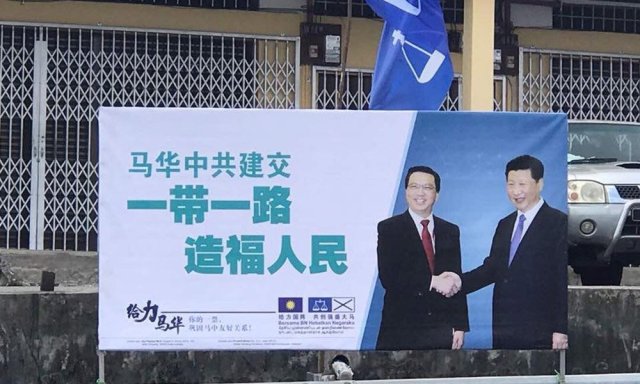
@liowtionglai, now this is new, Chinese Premier is a President/Vice-President of MCA as well, is this true? Clarify please, I am deeply confused.
…
The MCA President, Datuk Seri Liow Tiong Lai, should explain why he is putting up giant billboards of Xi Jinping in Bentong and in constituencies contested by MCA, and not billboards of the Barisan Nasional President and Prime Minister, Datuk Seri Najib Razak.

…
The Edge Markets @theedgemarkets
Malaysia grows skeptical of Chinese investment: Adam Minter
(May 8): Chinese President Xi Jinping won’t be on the ballot when Malaysians vote for a new government on Wednesday. But he is on election billboards. Although it’s probably not a role that Xi would’ve chosen for himself, China’s influence on Malaysia’s economy has become one of the most bitterly contested issues in a bruising campaign.
That’s certainly awkward for China, which presents itself as a champion of economic development around the world. Increasingly, though, its vision isn’t shared. In Malaysia and elsewhere, popular opposition to Chinese investment is rising, driven by the perception that its benefits flow only one way. In that sense, Malaysia’s election should be a wakeup call.
.
And China has indeed invested. So far, there are US$34 billion worth of government-backed projects underway, including a gas pipeline and the US$17 billion (at least) East Coast Rail Link. China’s private sector is splurging, too: Between 2012 and 2016, Malaysia received US$2.37 billion in Chinese real-estate investment, ranking it third among Belt and Road countries. Chinese money is also pouring into manufacturing, energy, and metals, as well as logistics and e-commerce.
Malaysia’s current government has welcomed these investments as needed infusions into an economy battered in recent years by low oil prices and scandal-driven financial uncertainty. But several factors have started turning Malaysians against them.
For one thing, there are widespread fears about how China is financing these big projects and whether Malaysia can actually meet its payments. Last year, Sri Lanka handed over its Port of Hambantota to Chinese state-controlled firms in return for US$1.1 billion in relief from debts incurred building the port. That development wasn’t missed in Malaysia, where China has been lending just as aggressively.
Chinese companies are also notorious for importing workers, equipment and materials from back home, rather than relying on local resources. In the case of Malaysia’s rail link, the government has even cited language barriers to defend the practice. Similar complaints have been aired from Ghana to the Philippines.
Chinese real-estate investment, meanwhile, has spurred jealousy, sovereignty concerns and occasional xenophobia. Between 2012 and 2016, foreigners accounted for about 35% of residential land transactions in Malaysia, with Chinese making up the majority. Most notable is the massive Forest City development off the Straits of Johor, which is expected to eventually have 700,000 residents. So far, 70% of the buyers have been Chinese. The units, costing upward of US$250,000, are out of reach for most locals.
Malaysia’s opposition, led by former Prime Minister Tun Dr Mahathir Mohamad, hasn’t shied away from exploiting these concerns. In a recent interview with Bloomberg News, Mahathir invoked both Sri Lanka’s loss of Hambantota and the surge of foreigners into Forest City as reasons to scrutinize China’s investment splurge. “No country wants to have an influx of huge numbers of foreign people into their country,” he said.
http://www.theedgemarkets.com/article/malaysia-grows-skeptical-chinese-investment-adam-minter
…
 weehingthong