
..
Cai Xia is a Chinese dissident and scholar of political theory. She has taught high-ranking members and officials of the Chinese Communist Party, including leading provincial and municipal administrators and cabinet-level ministers, and is a retired professor of the CCP Central Party School. Wikipedia
Since 2019 she has resided in the United States in exile. Wikipedia
..
Excerpts:
When Xi Jinping came to power in 2012, I was full of hope for China. As a professor at the prestigious school that educates top leaders in the Chinese Communist Party, I knew enough about history to conclude that it was past time for China to open up its political system. After a decade of stagnation, the CCP needed reform more than ever, and Xi, who had hinted at his proclivity for change, seemed like the man to lead it.
点击此链接阅读中文版 (Read in Chinese).
By then, I was midway through a decades-long process of grappling with China’s official ideology, even as I was responsible for indoctrinating officials in it. Once a fervent Marxist, I had parted ways with Marxism and increasingly looked to Western thought for answers to China’s problems. Once a proud defender of official policy, I had begun to make the case for liberalization. Once a loyal member of the CCP, I was secretly harboring doubts about the sincerity of its beliefs and its concern for the Chinese people.
So I should not have been surprised when it turned out that Xi was no reformer. Over the course of his tenure, the regime has degenerated further into a political oligarchy bent on holding on to power through brutality and ruthlessness. It has grown even more repressive and dictatorial. A personality cult now surrounds Xi, who has tightened the party’s grip on ideology and eliminated what little space there was for political speech and civil society. People who haven’t lived in mainland China for the past eight years can hardly understand how brutal the regime has become, how many quiet tragedies it has authored. After speaking out against the system, I learned it was no longer safe for me to live in China.
.
My vision—shared with other liberal scholars—was that China would start by implementing democracy within the party, which, over the long run, would lead to a constitutional democracy. China would have a parliament, even a real opposition party. In my heart, I worried that the CCP might violently resist such a transition, but I kept that thought to myself. Instead, when speaking with colleagues and students, I argued that such a transition would be good for China and even for the party itself, which could consolidate its legitimacy by making itself more accountable to the people. Many of the officials I taught acknowledged that the party faced problems, but they could not say so themselves. Instead, they cautiously urged me to persuade their superiors.
.
Thus it was with optimism that I looked to Xi when it became clear that he was going to take power. The easy reforms had all been made 30 years ago; now it was time for the hard ones. Given the reputation of Xi’s father, a former CCP leader with liberal inclinations, and the flexible style that Xi himself had displayed in previous posts, I and other advocates of reform hoped that our new leader would have the courage to enact bold changes to China’s political system. But not everyone had such confidence in Xi. The skeptics I knew fell into two categories. Both proved prescient.
The first group consisted of princelings—descendants of the party’s founders. Xi was a princeling, as was Bo Xilai, the dynamic party chief of Chongqing. Xi and Bo rose to senior provincial and ministerial positions at almost the same time, and both were expected to join the highest body in the CCP, the Politburo Standing Committee, and were considered top contenders to lead China. But Bo fell out of the leadership competition early in 2012, when he was implicated in his wife’s murder of a British businessman, and the party’s senior statesmen backed the safe and steady Xi. The princelings I knew, familiar with Xi’s ruthlessness, predicted that the rivalry would not end there. Indeed, after Xi took power, Bo was convicted of corruption, stripped of all his assets, and sentenced to life in prison.
The other group of skeptics consisted of establishment scholars. More than a month before the 18th Party Congress of November 2012, when Xi would be formally unveiled as the CCP’s new general secretary, I was chatting with a veteran reporter from a major Chinese magazine and a leading professor at my school who had observed Xi’s career for a long time. The two had just wrapped up an interview, and before leaving, the reporter tossed out a question: “I hear that Xi Jinping lived in the Central Party School compound for a period of time. Now he’s about to become the party’s general secretary. What do you think of him?” The professor’s lip twitched, and he said with disdain that Xi suffered from “inadequate knowledge.” The reporter and I were stunned at this blunt pronouncement.
In spite of these negative views, I willingly suspended disbelief and put my hopes in Xi. But shortly after Xi’s ascension, I started to have my doubts. A December 2012 speech he gave suggested a reformist and progressive mentality, but other statements hinted at a throwback to the pre-reform era. Was Xi headed left or right? I had just retired from the Central Party School, but I still kept in touch with my former colleagues. Once when I was talking to some of them about Xi’s plans, one of them said, “It’s not a question of whether Xi is going left or right but rather that he lacks basic judgment and speaks illogically.” Everyone fell silent. A chill ran down my spine. With deficiencies like these, how could we expect him to lead a struggle for political reform?
.
The tycoon, Ren Zhiqiang, had increasingly come into conflict with Xi, whom he criticized for censoring Chinese media. In February 2016, a CCP website labeled Ren as “anti-party.” I didn’t know Ren personally, but his case struck me as especially disturbing because I had long relied on the principle that within the CCP, we were allowed—even encouraged—to speak freely in order to help the party correct its own mistakes. Here was a longtime party member who had been demonized for doing just that. Having lived through the Cultural Revolution, I knew that people branded with the label “anti-party” were deprived of their rights and subjected to harsh persecution. Since a defense of Ren could never be published in censored media outlets, I wrote one up and sent it to a WeChat group, hoping my friends would share it with their contacts. My article went viral.
Although most of my article simply quoted the party’s constitution and code of conduct, the Central Party School’s disciplinary committee accused me of serious errors. I faced a series of intimidating interviews in which my interrogators applied psychological pressure and laid word traps in an effort to induce a false confession of wrongdoing. It was uncomfortable, but I recognized the process as a psychological contest. If I didn’t show fear, I realized, they would lose half the battle. And so a stalemate ensued: I kept publishing, and the authorities kept calling me in for questioning. Soon, I concluded that security agencies were tapping my phone, reading my digital correspondence, and following me to see where I went and with whom I met. Retired professors from the Central Party School usually need permission only from the school to travel to Hong Kong or abroad, but now the school hinted that I had to clear such trips with the Ministry of State Security in the future.
.
In all my years as a member of the CCP, I had never violated a single rule, nor had I ever been called in for a reprimand. But now, I was regularly interrogated by party officials. The school’s disciplinary committee repeatedly threatened the humiliating prospect of holding a large public meeting and announcing a formal punishment. At the end of each conversation, my interrogators demanded I keep it a secret. It was all part of an underworld that couldn’t be exposed to the light of day.
Then came a cover-up of police brutality that triggered my final break with Xi and the party. Earlier, in May 2016, Lei Yang, an environmental scientist, was on his way to the airport to pick up his mother-in-law when, in circumstances that remain murky, he died in the custody of the Beijing police. In order to evade responsibility for the crime, the police framed Lei, alleging that he had been soliciting a prostitute. His classmates from his university days, outraged at this attempt at defamation, banded together to help his family seek justice, starting a campaign that reverberated throughout China. To quell the fury, the CCP’s top leaders ordered an investigation. The prosecution agreed to an independent autopsy, and a trial was scheduled to argue the matter.
A strange thing happened next: Lei’s parents, wife, and children were put under house arrest, and the local government offered them massive compensation, about $1 million, to give up their pursuit of the truth. When Lei’s family refused, the payment was increased to $3 million. Even after a $3 million house was thrown in, Lei’s wife insisted on clearing her late husband’s name. The government then pressured Lei’s parents, who knelt before their daughter-in-law and begged her to abandon the case. In December, prosecutors announced that they would not charge anyone for Lei’s death, and his family’s lawyer revealed that he had been forced to stand down.
.
After 20 years of hesitation, confusion, and misery, I made the decision to emerge from the darkness and make a complete break with the party. Xi’s great leap backward soon left me with no other choice. In 2018, Xi abolished presidential term limits, raising the prospect that I would have to live indefinitely under neo-Stalinist rule. The next summer, I was able to travel to the United States on a tourist visa. While there, I received a message from a friend telling me that the Chinese authorities, accusing me of “anti-China” activities, would arrest me if I returned. I decided to prolong my visit until things calmed down. Then the COVID-19 pandemic broke out, and flights to China were canceled, so I had to wait a little longer…I received urgent phone calls from the authorities at the Central Party School demanding that I come home.
But the atmosphere in China was growing darker. Ren, the dissident real estate tycoon, disappeared in March and was soon expelled from the party and sentenced to 18 years in prison. Meanwhile, my problems with the authorities were compounded by the unauthorized release of a private talk I had given online to a small circle of friends in which I had called the CCP “a political zombie” and said that Xi should step down. When I sent friends a short article I had written denouncing Xi’s repressive new national security law in Hong Kong, someone leaked that, too.
I knew I was in trouble. Soon, I was expelled from the party. The school stripped me of my retirement benefits. My bank account was frozen. I asked the authorities at the Central Party School for a guarantee of my personal safety if I returned. Officials there avoided answering the question and instead made vague threats against my daughter in China and her young son. It was at this point that I accepted the truth: there was no going back.
Read the whole article here:
https://www.foreignaffairs.com/articles/china/2020-12-04/chinese-communist-party-failed?utm_source=twitter_posts&utm_medium=social&utm_campaign=tw_daily_soc
..
Excerpts:
China’s Cai Xia: former party insider who dared criticise Xi Jinping
Prominent dissident explains how she came to doubt her fervent beliefs in party orthodoxy
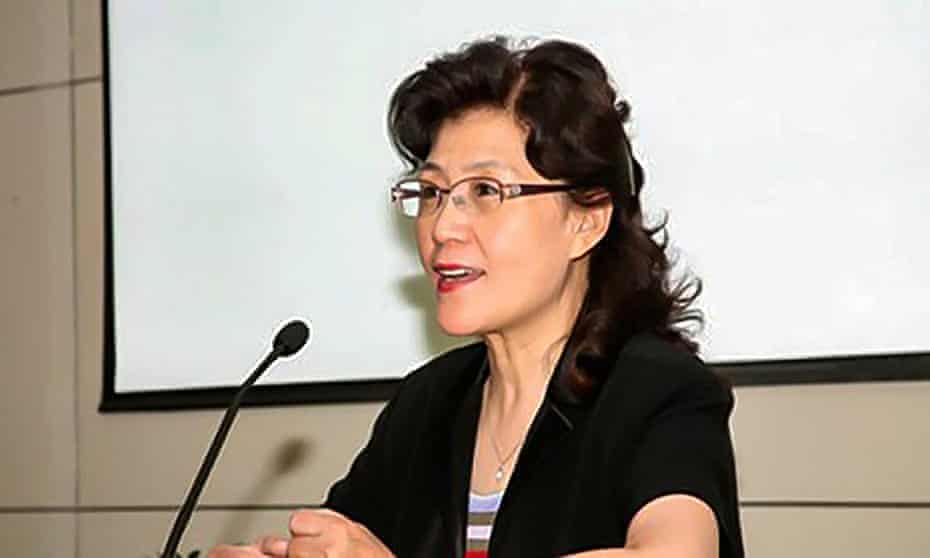
Cai Xia was a professor at the Chinese communist party’s influential central school. Photograph: Radio Free Asia
Lily Kuo in BeijingFri 21 Aug 2020 12.19 BST
Last modified on Fri 21 Aug 2020 16.06 BST
In the mid-1990s, Cai Xia, a devout believer in Chinese communist doctrine, experienced her first moment of doubt.
She was a teacher at the central party school for training cadres when a friend called with some questions. Cai, an expert in Marxism and Chinese communist party theory, enthusiastically answered.
She remembers how the friend, after listening to her responses, then asked: “Do you think communism can really be implemented?”
Cai, who at that point had spent decades serving the party, was shocked. “No one had ever asked me this. I always felt everything I did was normal and natural, and I never thought about whether it was right or wrong,” she said.
The friend followed up with another pointed question: “Do you know what you are like, what you are?” To Cai’s confusion, the friend said: “You are a preacher of the communist party,” – a proselytiser verging on religious fanaticism.
“I knew being called a preacher for the Chinese communist party was a derogatory term,” she said, noting the negative connotation of religion within the party. “These two questions lodged in my mind,” she said. “I still think about them.”
Over the past week, Cai, 68, has become a celebrated dissident to some and a reviled traitor to others. On Monday, she was expelled from the party after comments of hers calling the Chinese leader, Xi Jinping, a “mafia boss” were leaked online in June.
Following her expulsion, Cai gave the Guardian permission to release a previously unpublished interview with her in which she went even further, blaming Xi for “killing a party and a country” and turning China into “an enemy” of the world – extremely rare criticisms of the top leader from within the party establishment.
In the days since, state media have called Cai “a traitor” and an “extreme dissident” aligned with anti-Chinese forces in the US. “She has betrayed not only the oath of the party but also the interests of China and the Chinese people,” the nationalist outlet Global Times wrote.
The central party school held a special meeting this week to strengthen discipline to prevent “major political incidents” as well as increase the political and ideological training of retired staff.
“Party organisations at all levels and the entire school’s faculty and staff should take profound lessons from Cai Xia’s serious disciplinary violations,” the school said in a notice.
Yet Cai, who has been overseas since last year, said she had lost neither sleep nor appetite, nor suffered anxiety from these attacks.
“Whatever other people say, I will not be moved. I only care about whether my understanding is right or wrong. If it is wrong, I will fix it. If it is right, no matter what pressure I come under I will persevere. This is just my personality,” she said. “I know what I need to do.”
Read the article here:
..
 weehingthong