
…
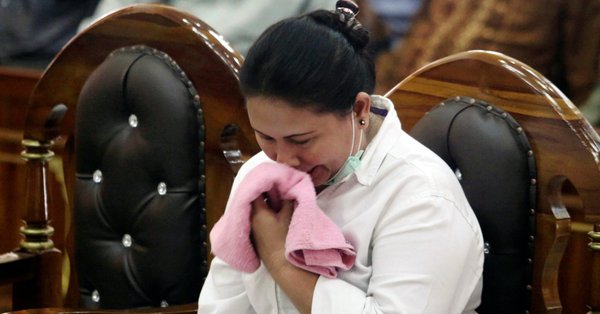
An Indonesian court sentenced Meiliana, an ethnic Chinese Buddhist woman, to 18 months in prison for blasphemy, after she was accused of insulting Islam for complaining that the loudspeaker of a neighborhood mosque was too loud.
…
…
26 August 2018
Except for the azan (Islamic prayers), mosques in Indonesia have been asked not to broadcast sounds when most people are likely to be sleeping, resting, and praying.
They have also been asked not to raise sound levels while conducting a prayer.
Indonesia’s Ministry of Religious Affairs has issued a circular on azan or the Islamic call to prayer, with guidelines on when and how it ought to be broadcast by mosques across the country, amid an outcry over the jailing of a woman who had griped about azan volumes to a neighbour.
Titled “The use of loudspeakers in Mosques, Langgar, and Musholla”, the circular released on Friday (Aug 24) urges religious institutions to follow the instructions of the director-general of Muslim guidance, Tempo news portal reported on Saturday (Aug 25). Langgar and Musholla are terms used in Indonesia for Muslim prayer houses.
The directive came three days after a 44-year-old woman of Chinese descent and Buddhist faith was found guilty of blasphemy and sentenced to 1 1/2-year jail by the Medan district court.
.
…
25 August 2018
An Indonesian woman was sentenced to 18 months in prison this week. Her crime? Saying that a mosque near her home was cranking up the volume too high during the call to prayer.
As of today (Aug. 24), more than 100,000 people have signed an online petition in protest. Amnesty International condemned the ruling, saying, “Making a complaint about noise is not a criminal offense. This ludicrous decision is a flagrant violation of freedom of expression.”
The nation’s two largest Islamic organizations—Nahdlatul Ulama (NU) and Muhammadiyah—have also spoken against the ruling. NU said complaints about a mosque’s loudspeakers should not be considered blasphemy. “I hope officers of the law do not use the blasphemy law as an instrument to suppress freedom of expression,” Robikin Emhas, who sits on NU’s board, said after the ruling.
Muhammadiyah secretary Abdul Mu’ti said the sentence was “too heavy” and called for an in-depth review of blasphemy-related articles and laws, arguing provisions were vague and open to interpretation. Under the nation’s criminal code (pdf, p. 27), anyone who “deliberately” abuses a religion in public may be sentenced to up to five years. Critics contend the laws are used to bully minorities.
.
The woman sentenced, Meiliana, is an ethnic Chinese Buddhist who lives on the island of Sumatra. Her comments, made in a private conversation in 2016, sparked riots in which Muslims attacked Buddhist temples. Her legal team contended those comments were twisted to make it seem she objected to the call to prayer itself, and then repeated on social media.
A year earlier, Indonesian vice president Jusuf Kalla—a member of the Indonesian Mosque Council—said that places of worship should turn down their sounds systems to avoid agitating people living nearby.
Unlike Meiliana, he was not prosecuted for saying so.
https://qz.com/1368912/indonesian-blasphemy-verdict-too-much-even-for-islamic-organizations/
…
 weehingthong
Pingback: No, Indonesia isn’t that wonderful a country: Ahok, Chinese and Christian ex Governor of Jakarta, was sent to prison for blasphemy! | weehingthong