
…
2018
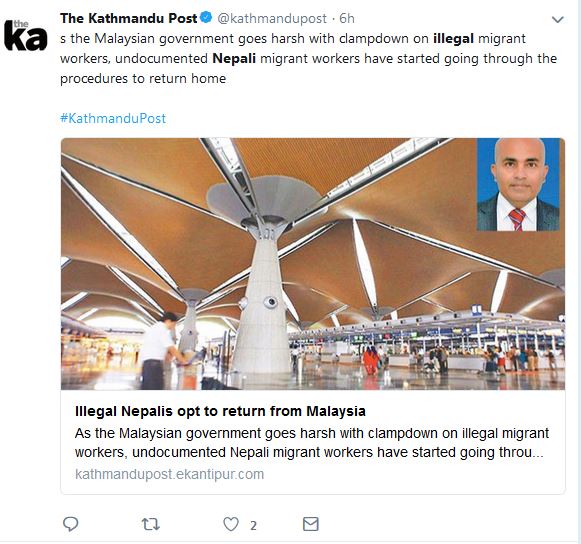
Earlier this year the Nepal government stopped the migration of Nepali workers to Malaysia and closed many agencies believed to have illegally demanded additional money for providing visa-processing services. The government had also taken punitive action against employment agencies and individual agents this year, local news reports said.
The media reports named Malaysia VLN Nepal, Nepal Health Professional Federation, One Stop Centre (OSC) and GSG Nepal as among those affiliated to Bestinet and the migrant worker scheme.
Last month, Bestinet denied any involvement in a scheme that was purportedly trafficking in Bangladeshi migrant workers.
…
PETALING JAYA – The government of Nepal has barred its workers from coming to Malaysia with immediate effect.
The move comes as the Nepalese government expressed its unhappiness with “restrictive” immigration requirements its workers faced before they can be gainfully employed in this country. This includes having to go through a private company for security and medical check-ups as part of the visa requirement.
Nepal Embassy labour attache Sanmaya Ramtel confirmed that her government has indefinitely barred its citizens from seeking employment in Malaysia. The official told The Star that the government had identified several discrepancies in the recruitment process of migrant workers in Malaysia.
“The Nepalese government does not understand why the Malaysian Government is allowing a private company to monopolise the recruitment process.
“The government also feels that the company’s presence is a virtual monopoly as other companies are not allowed to carry out the screening and this contributes to higher cost for the workers,” she said.
Malaysia, the official said, was among the top two destinations for Nepalese migrant workers seeking job opportunities outside their country.
Furthermore, she said, the Gurkas from Nepal were the only category of foreign workers sought by Malaysia to work in the security line.
“This has been a long-standing dispute between the Nepalese and Malaysian governments.
“However, the change of government in Nepal which took place in February this year saw the new government taking a firm stand on the matter,” Sanmaya said.
A source from the recruitment industry told The Star that employers are now having difficulty hiring Nepali workers.
The source said the issue was over the involvement of Bestinet Sdn Bhd, which is the sole party that carries out bio-medical screening for migrant workers entering Malaysia.
It is learnt that there are currently more than 500,000 Nepalese workers in Malaysia. About 150,000 of them are hired as security guards, while the rest are involved in construction and manufacturing.
http://www.malaysia-chronicle.com/?p=125196
…
..
24 July 2018
A deeply-rooted nexus of politicians, businessmen and bureaucrats in Nepal and Malaysia have looted more than Rs5 billion over the past five years from vulnerable Nepali migrant workers desperate to seek work in Malaysia.
Nepal’s Labour Minister Gokarna Bista is trying to dismantle those involved in the exploitation by cracking down on several Kathmandu-based companies set up to extort fees from overseas contract workers. In Malaysia itself, the newly-elected Prime Minister Mahathir Mohammad has also launched an investigation into the previous government’s involvement in profiting from migrant workers.
The scam involved powerful Malaysian businesses with close links to ministers and officials in the Barisan Nasional coalition of former Prime Minister Najib Razak and implemented by their agents in Kathmandu who had contacts with influential politicians and bureaucrats in Nepal.
https://www.nepalitimes.com/banner/kleptocrats-of-kathmandu-and-kualalampur/
…
23 July 2018
..

…
…
22 July 2018
..
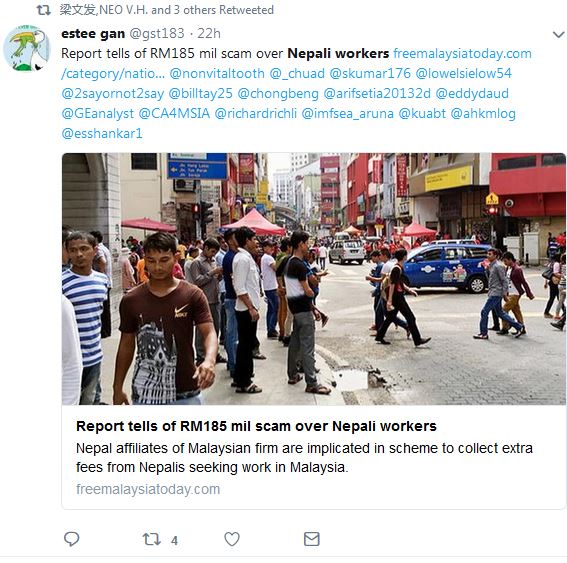
PETALING JAYA: Nepali businessmen and officials made more than 5 billion Nepal rupees (RM185 million) over the past five years from Nepalis seeking work in Malaysia, according to a news report.
The report said the money came from fees for visas and biometric screening involving Nepali companies affiliated with Malaysia’s Bestinet Sdn Bhd, which developed a foreign worker system for the Immigration Department.
Bestinet has been involved in controversy over its links to former home minister Ahmad Zahid Hamidi and several Umno politicians, and with Bangladesh middlemen who made huge profits from Bangladeshi migrant workers.
The Malaysia government said in May that all agreements for bringing in foreign migrant workers were being reviewed, includng a scheme to bring workers from Bangladesh over three years.
Today’s report in the Nepali Times newspaper said: “Tallied together, the Malaysia government and companies backed by powerful politicians have, in total, taken more than Rs5 billion from over 600,000 Nepali workers between September 2013 and April 2018.
“Nepali politicians, bureaucrats and businesses were directly colluding with their Malaysian counterparts in cheating the workers. There are over 600,000 Nepali workers in Malaysia, and their remittances help sustain Nepal’s economy.”
..
..
Report implicates Malaysian, Nepali officials in migrant worker registration ‘scam’
KUALA LUMPUR, July 22 — A Nepali news outlet has accused firm linked to former deputy prime minister Datuk Seri Ahmad Zahid Hamidi of extracting Rs5 billion (RM185 million) from the country’s migrant workers over the past five years.
Describing the work visa application fees as “extortionate,” Nepali Times also asserted that the country’s Labour Minister Gokarna Bista was working to undo the scheme in a local crackdown.
The firm in question is Bestinet Sdn Bhd, which previously listed former home minister Tan Sri Azmi Khalid as a director and which Nepali Times alleged was operated by a relative of Zahid.
It was awarded the exclusive contract to handle the biometric registration of foreign workers, which Malaysia made mandatory for Nepali migrant workers in 2015.
Nepali workers intending to work in Malaysia could previously register with any of the country’s employment agencies for Rs700 (RM26), following a health check at any government-approved clinic.
After the 2015 development, however, the fee rose to Rs4,500 (RM167) due to a requirement for the health screening to be conducted at one of only 39 approved centres.
“The real scam involved the lack of transparency in Malaysia and in Nepal on the choice of the private companies hired to facilitate this process, which ended up fleecing workers,” the report alleged.
“While in Malaysia the companies were partly-owned by relatives of politicians, in Nepal bureaucrats and politicians benefited from kickbacks for sanctioning the new system. Fees were added on arbitrarily, and all involved in the syndicate in the two countries divided up the profits.”
Among others, the news outlet noted that while the cost already rose over four-fold for the application screening, it was not all a prospective worker must pay.
The worker must also authorise One Stop Centre (OSC), a Malaysia-appointed firm, to arrange for the collection of documents for delivery to the country’s embassy in Kathmandu, for which it charged an additional Rs2,800.
In Malaysia, it said Bestinet also imposed a Rs3,200 fee for document scanning and fingerprinting as well as another Rs3,500 to simply make the data available online.
“Tallied together, the Malaysia government and companies backed by powerful Malay politicians have, in total, taken more than Rs5 billion from over 600,000 Nepali workers between September 2013 and April 2018.
“Nepali politicians, bureaucrats and businesses were directly colluding with their Malaysian counterparts in cheating the workers,” the news outlet alleged.
…
21 July 2018
A deeply-rooted nexus of politicians, businessmen and bureaucrats in Nepal and Malaysia have looted more than Rs5 billion over the past five years from vulnerable Nepali migrant workers desperate to seek work in Malaysia.
Nepal’s Labour Minister Gokarna Bista is trying to dismantle those involved in the exploitation by cracking down on several Kathmandu-based companies set up to extort fees from overseas contract workers. In Malaysia itself, the newly-elected Prime Minister Mahathir Mohammad has also launched an investigation into the previous government’s involvement in profiting from migrant workers.
The scam involved powerful Malaysian businesses with close links to ministers and officials in the Barisan Nasional coalition of former Prime Minister Najib Razak and implemented by their agents in Kathmandu who had contacts with influential politicians and bureaucrats in Nepal.
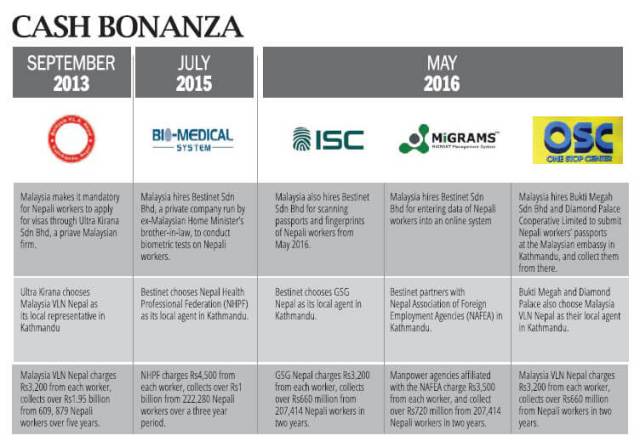
It all started five years ago when Malaysia’s Home Minister Ahmad Zahid Hamidi outsourced a private company (Ultra Kirana Sdn Bhd) which required Nepali migrant workers to apply for work visas through a Kathmandu-based affiliate, Malaysia VLN Nepal. The agency charged Rs3,200 from every Malaysia-bound Nepali worker, and collected Rs 1.95 billion from more than 600,000 workers between September 2013 and April 2018.
Then in July 2015, Malaysia made it mandatory for all Nepali migrants to undergo a biometric test. The Malaysian government hired Bestinet Sdn Bhd, a tech firm run by Malaysian Home Minister Hamidi’s brother-in-law Amin Bin Abdul Nor, for biometric health screening. Minister Hamidi’s brother Abdul Hakim Hamidi and ex-Malaysian Environment Minister Ajmi Khalid also reportedly owned shares in Bestinet.
Bestinet partnered with Nepal Health Professional Federation (NHPF) to carry out biometric screening through 39 medical centres which charged Rs4,500 from each migrant worker for biometrics. Bestinet and NHPF have already collected over Rs1 billion from over 200,000 Nepali workers.
.
…In May 2016, Malaysia hired another private company, One Stop Centre (OSC) to collect visa forms and passports and drop them at its embassy in Kathmandu. The OSC chose the same Malaysia VLN Nepal for this job, which added an extra fee of Rs2,800 from each applicant.
Bestinet has also been allowed to charge each migrant worker Rs3,200 just for scanning passports, fingerprinting and an additional Rs3,500 to upload the data online. Bestinet’s Kathmandu-based agent, GSG Nepal, scans passports and fingerprints for all Malaysia-bound migrant workers. Bestinet in turn collaborated with labour recruitment agencies in Kathmandu and has so far collected over Rs1.3 billion in fees for passport and fingerprints scanning, and online data entry.
Tallied together, the Malaysia government and companies backed by powerful Malay politicians have, in total, taken more than Rs5 billion (US$ 450 million) from over 600,000 Nepali workers between September 2013 and April 2018. Nepali politicians, bureaucrats and businesses were directly colluding with their Malaysian counterparts in cheating the workers. There are over 600,000 Nepali workers in Malaysia, and their remittances help sustain Nepal’s economy.
The arrangements have been put into place on an ad hoc basis, without transparency and in the absence of any bilateral agreements between the governments of Nepal and Malaysia. Some of the companies managing migration in Nepal do not even have government approval.
.
https://www.nepalitimes.com/banner/kleptocrats-of-kathmandu-and-kualalampur/
…
Linking Bestinet director to Umno, PKR casts doubt over foreign worker database deal
KUALA LUMPUR, Jan 27 — PKR revealed today a former Labour Department director-general as the second director of controversial IT firm Bestinet Sdn Bhd, after naming an ex-home minister as another director last week.
According to two PKR lawmakers, Datuk Tengku Omar Bot holds over 99 per cent of Bestinet’s shares, allegedly due to his close friendship with former minister Tan Sri Azmi Khalid.
“He has a close relationship with former minister Azmi Khalid. They also have mutual interest in other companies such as Rafflescare,” Datuk Johari Abdul and Lee Chean Chung said in a joint statement, referring to a foreign worker management firm.
They also claimed that Tengku Omar holds the shares through his company JR Joint Resources Holding Sdn Bhd.
Just like Bestinet, the lawmakers claimed that JR is also a RM2-worth shell company which has not filed its annual report for the last four years.
“Their latest financial report was sent in 2007 and this contravenes the Companies Act 1965,” they said.
A check with the Companies Commission of Malaysia by Malay Mail Online today supported their allegations.
On January 17, the lawmakers had earlier expressed concern after finding out that all medical checkups and the application of visa with reference (VDR) for foreign workers must now be done through Bestinet’s Foreign Workers Centralised Management System (FWCMS) from January 15.
They also questioned the cost behind the system, and asked if the contract had been awarded via open tender.
…
 weehingthong
1001 scams online