
…
…
27 April 2019
..
Teresa Kok: The opposition love me
INTERVIEW | Teresa Kok is prepared to face ridicule if it means she does a good job at promoting the palm oil industry.
The DAP deputy secretary-general was sworn-in as the primary industries minister in July 2018 and as a city-bred politician has been mocked in the course of learning on the job.
She took the job on just as Putrajaya had to combat the European Union’s (EU) effort to ban the use of palm oil-based biofuels, which would worsen climbing stockpiles and overproduction of palm oil.
The continuous plunging of the palm oil price impacted 650,000 smallholders and affect the livelihoods of three million people who were depending on the palm oil-related industry.
It also arguably played a role in the defeat of Barisan Nasional in 2018 general election.
Kok has been teased for ‘hard-selling’ palm oil by claiming she looked younger by taking red palm oil a spoon every day.
She was criticised for suggesting rubber tappers work during monsoon season and urged the smallholders to diversify their crops.
In an interview with Malaysiakini and KiniTV, the unfazed politician defended her move to hard sell palm oil.
“Some Malaysians give a gift hamper with coconut oil or olive oil. My question is why does nobody give red palm oil?” she asked when touting its health value.
“Actually, we have been soft-selling (palm oil) until many Malaysians themselves do not know the benefit of palm oil,” pointed out the Seputeh MP.
“If Malaysians know about the benefit of palm oil and if (we do not) face challenge in (selling) palm oil, there is no need for pushing ‘Love MY Palm Oil’ campaign,” she said.
“When I remained quiet, others liken me to MCA. When I spoke out for palm oil, people are saying I am hard-selling. So, what should I do ?” she asked.
Willing to bear ridicule
The optimistic minister said she liked to draw positives when opposition lawmakers constantly criticised her over palm oil in Parliament.
“I have been a parliamentarian for 20 years. When did you see these kind of exchanges in relation to the primary industries ministry? Nobody ‘kacau’ (harass) my predecessors,” she said.
“Only in my tenure that you see them participate in debate and twist my words by saying (I told smallholders) to forget about palm oil and plant bamboo instead. (They) put words into my mouth and (attempted) to run me down,” she said.
“I can only say that they love me, they love me so much that whatever I say they love to twist it. (But) I am so used to, I am the target and they love to whack me.
“The more they poke fun at me on palm oil, the more attention given to palm oil. Indirectly they are helping the cause,” she said.
The opposition politicians wanted to appeal to their constituents, who comprise smallholders, according to her.
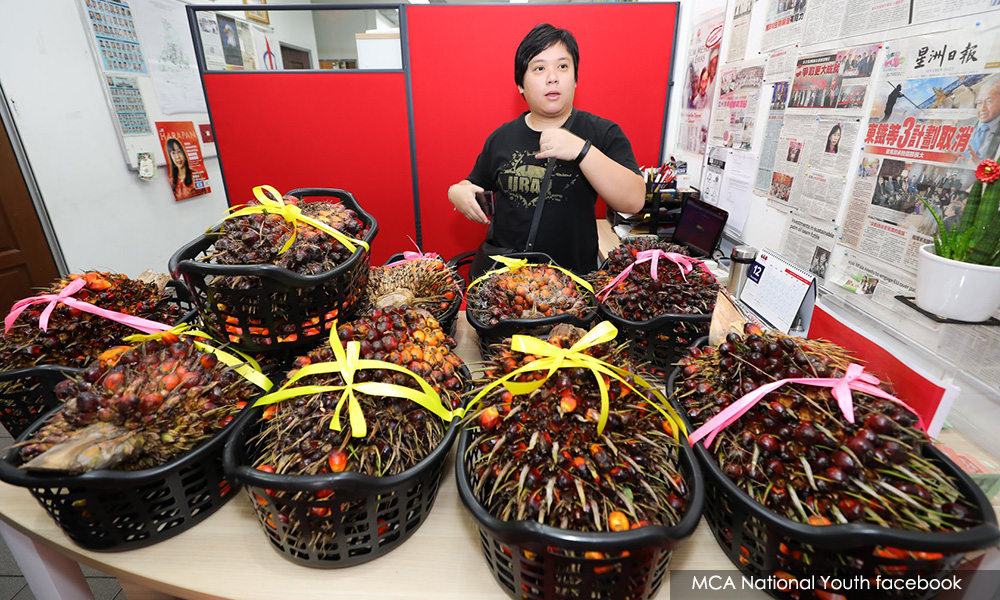
It was Prime Minister Dr Mahathir Mohamad who first spoke about consuming one spoon of palm oil per day instead of her, she said.
“(On several occasions when Mahathir attended palm oil events), he never used the speech texts we drafted, (he spoke off the cuff),” she added.
Kok is planning a trip to Europe early next month to explain the efforts done by both the government and the corporate sectors to preserve the environment.
“The European parliament election will be held in May and both climate change and palm oil issue are on the agenda. So we do not put much hope in European Parliament and European Commission as they had made their stands,” she said.
The proposed EU Delegated Act, which classifies palm oil as ‘high risk’ oil, is slated to be tabled in European Parliament in May 2019. The Act will supplement the EU Renewable Energy Directive (RED) II to restrict and ban palm oil biofuel by 2030.
The sales of other palm oil-based products in EU market are expected to be impacted as well.
EU leaders need to hear ‘good stories’
Malaysia exports 1.9 million tonnes of palm oil to the economic bloc annually and the EU is the second largest palm oil market for Malaysia.
Kok said she still needs to meet the government leaders of these countries to explain the efforts of reforestation and wildlife preservation by both the government and the palm oil industry in particular.
She said these ‘good stories’ were not reported.
“We have purchased and imported lots of products from Germany and France. It is crucial for both countries to look at our trade balance.
“It is important to talk to individual countries and ministers and make them understand efforts done by Malaysia,” she said.
Other ongoing efforts by Putrajaya include moves to clear the palm oil stockpiles, explore new markets and push for more domestic consumption.
Palm oil stockpiles currently stand at slightly below three million tonnes, approximately one million extra than normal level.
For example, she said Putrajaya mulled pushing for the usage of B20 (20 percent palm oil and 80 percent diesel) after the implementation of B10 in 2018.
“Joko Widodo, in his bid for second presidential term has pledged for B100. Malaysia should do the same and we can clean up the air,” she said.
She said the business community has taken the initiative to join Putrajaya in its palm oil campaign.
…
25 April 2019
KUALA LUMPUR: China will buy an additional 1.9 million tonnes of palm oil from Malaysia over the next five years, Malaysia’s state news agency Bernama said today, citing the minister of primary industries.
China is Malaysia’s third largest palm oil buyer, and imported 1.9 million tonnes from the country last year.
Malaysia has been trying to reduce its palm oil stockpiles, which hit the highest in at least 19 years last December, in a bid to shore up prices.
…
INTERVIEW | DAP never kept silent on many prominent issues, as its critics claim, the party’s deputy secretary-general Teresa Kok said.
Being known as a vocal party, DAP is now being criticised for not being critical on many prominent issues and unable to keep the federal cabinet in check when there is a policy flip-flop and promises made that are not fulfilled.
Particularly, critics have likened the DAP of today to the MCA, which was seen as docile when it was in power, together with the other BN members, up to May 2018.
“I don’t think that DAP is a party that kept silent,” Kok rebutted in an interview with Malaysiakini and KiniTV when questioned on this matter.
She said she felt that the critics of the DAP wanted the party to continue like an opposition state and slam (the ruling government) whenever it was unhappy with an issue.
“Of course, we still speak out (when necessary). But how do we do that? Should we do it openly, just like previously in Lynas issues where two cabinet ministers hit the headlines?
“Is this what you call voicing out for the people? No, I don’t think so,” said Kok, who is also primary industries minister.
“On issues that have been twisted (by others), we remained silent, but raised them in the cabinet. This is better than saying them openly in public,” Kok added.
She was referring to the statement made by Entrepreneur Development Minister Mohd Redzuan Yusof against the Energy, Science, Technology, Environment and Climate Change Ministry on the Lynas issue.
Redzuan had argued that the position taken on Lynas, the Australian rare-earth mining company, by Energy Minister Yeo Bee Yin was not endorsed by the cabinet.
In December 2018, the Energy Ministry said it would not accept the unlimited accumulation of waste at Lynas’ rare-earth processing plant in Gebeng, Kuantan.
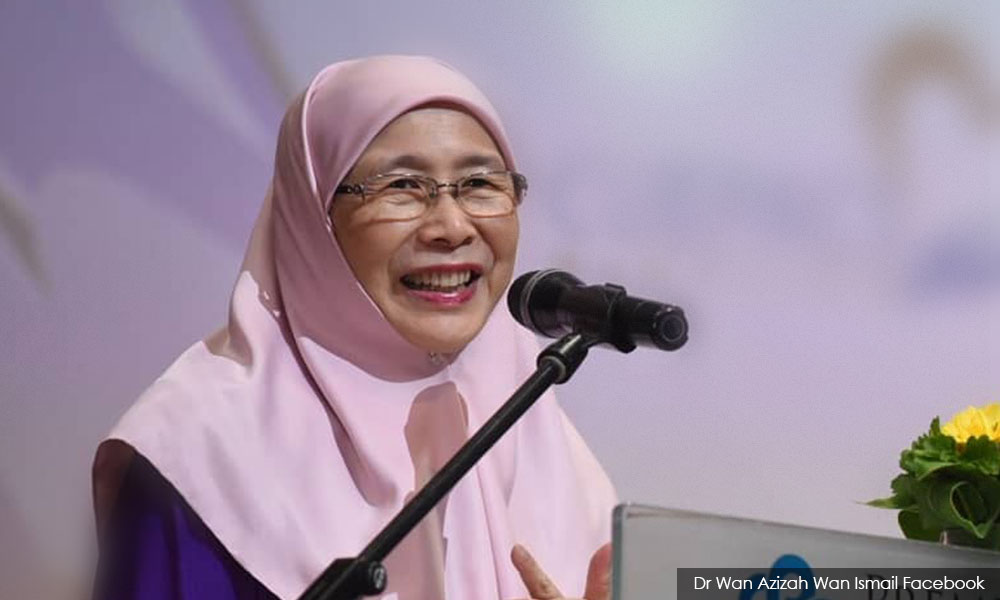
Deputy Prime Minister Dr Wan Azizah Wan Ismail (photo) had downplayed the matter as ‘healthy debate’ between both ministers.
DAP just avoided from meddling in another minister’s affair, Kok said.
“Some of the issues are being handled by another minister. There is no reason for us to voice out as we are in the same pact.
“Are you saying that I am quiet? No, I appear in many of the events related to the affairs of my ministry. My main concern is the ministry,” Kok added.
DAP cautious when its rivals harp on race
She also acknowledged that DAP was cautious, particularly when its rivals harped on race, religious and royal institution issues.
This was particularly so when Prime Minister Dr Mahathir Mohamad dealt with the Johor ruler on the matter of the replacement of the state menteri besar.
“The opposition accused the Chinese in DAP of controlling the government. So, in an incident involving the ruler, if DAP constantly voices out, will this help (to resolve) the situation?” she asked.
Despite none in DAP and a few in the Pakatan Harapan coalition allies backing Mahathir openly in his exchange with the Johor ruling family, she said Mahathir has the backing of the entire cabinet.
The cabinet ministers under the Harapan administration have more real power compared with MCA and Gerakan ministers under the previous administration.
“I bumped into my predecessor. He lamented that I have the power to appoint the head of an agency and department under my portfolio. Unlike his time, these appointments, political in nature, were decided by the Prime Minister’s Department,” Kok said, without naming any ministry or party.
Citing the Ministry of Transport, she said the former minister, Liow Tiong Lai, had less power compared with the incumbent minister Anthony Loke, as many of the agencies parked under his ministry were transferred out.
“So, when we go into specifics, we (DAP and MCA) are not the same,” she said.
.
In the past 11 months, some minister, who had difficulties adjusting to the steep learning curve, were criticised for their performance, causing some in the grassroots to complain that Mahathir has not provided sufficient guidance to the cabinet in his second stint as prime minister.
However, Kok said there was no autopilot in the Mahathir administration, as the prime minister made constant public appearances and spoke out on many issues.
“However, he is more relaxed (in his grip on the executive) to allow the ministers to have their say in their policies,” she added.
There were times Mahathir, chairing the weekly cabinet meetings, joked about how people labelled him as a dictator, she said.
“So, he said now he would listen to what we had to say. In the event where his view was different from ours, (he allowed) the majority rule,” she said.
To a question on whether she now perceived that Mahathir was not a dictator as many claimed, Kok said that depended on the situation.
“There were times he needed to make a swift decision on key issues, but was unable to discuss with the cabinet and he needed to do (decide),” she said.
“When we form a pact with different parties, sometimes (we) need to give and take and have a lot of understanding, particularly when some parties harp on religious and race issues,” Kok said.
Generally, she added, there is mutual respect between Mahathir and his Harapan allies.
Part 1 of this Interview:
Harapan will not be a one-term gov’t, vows minister
https://www.malaysiakini.com/news/473179
…
malaysiakini.comVerified account @malaysiakini
Harapan will not be a one-term gov’t, vows minister
INTERVIEW | With criticism raining on the 11-month-old Pakatan Harapan government for purportedly failing to fulfil its manifesto promises and policy flip-flops, compounded by a string of by-election defeats, there is growing concern that it will not be in power beyond a single term.
In an interview with Malaysiakini and KiniTV, Primary Industries Minister Teresa Kok acknowledged the growing dissatisfaction with Harapan, but believes the ruling coalition can turn the tide after the people see a discernable difference in governance.
Kok pointed out that some of Harapan’s supporters are unhappy because they expected changes to happen overnight.
“They failed to see that we are inheriting a company (government) with a huge debt and one full of problems, including structural problems,” she said.
“When people blame (us) for the bad economy, we shouldn’t forget that the world’s economy is worsening due to US-China trade war, with surrounding countries also suffering,” she explained.
The DAP deputy secretary-general also said some are unhappy due to efforts made to ensure taxes are paid and study loans repaid.
.
“I, however, do not believe that we are going to be one-term government,” she stressed, citing the now-defunct Pakatan Rakyat taking over the governments of Penang and Selangor in 2008, and holding onto power in subsequent elections.
Back then, Kok said, these state governments encountered a similar sentiment, prompting some to opine that the coalition would not last.
“In Selangor, we faced lots of problems, and demonstrations were held on a monthly basis. And yet, we could survive for three terms,” said Kok, who served on the state cabinet.
‘Listen to the people’
In order to stay beyond a single term, Kok said, Harapan needs to listen to public feedback while expediting its reform agenda.
“We understand that times now are bad for both business folk and ordinary people, and we are trying our best to improve that.
“We are not a perfect government, we have our own weaknesses. Some of the leaders might have acted unwisely in the past, we were no saints,” the Seputeh MP admitted.
.
“But I am confident that when we bring improvements to the economy, bring changes to the institutions, and show we are serious in combating corruption, Malaysians, including the Malay community, will support us.
“I feel that people will see in five years that we are a more ideal government compared with BN,” she said.
Besides ensuring that DAP can hold onto its largely urban and semi-urban constituencies, Kok added, her party also has to make sure its allies can defend their respective seats.
Harapan, which won 121 parliamentary seats and captured eight states in the 14th general election together with Warisan, is said to be suffering from a trust deficit ahead of its one-year anniversary in federal power on May 9.
The ruling coalition now has 139 MPs after accepting defecting lawmakers from opposition parties, including Umno.
A survey conducted by the Ilham Centre and Penang Institute three months ago showed that 60 percent of the Malay respondents were not happy with Harapan’s performance.
.
Subsequently, the coalition lost three consecutive by-elections held for the Cameron Highlands and Semenyih parliamentary seats, and the Rantau state seat.
Externally, the ruling coalition faces a growing threat from the Umno-PAS pact, which forced the government to abandon its plans to ratify two international treaties – the International Convention on the Elimination of All Forms of Racial Discrimination (Icerd) and the Rome Statute of the International Criminal Court.
Kok revealed that the cabinet was united in its decision not to proceed with the ratification of both treaties.
“Let’s face reality. Sixty percent of the voters in Malaysia are bumiputera. At this stage, we are busy with reforming the country, wiping out the corruption, but the opposition is ganging up to attack us.
“So we need to be wise in our approach,” she said. “Sometimes, it is better to take a step back for the sake of the bigger picture and when the people are not ready, rather than go ahead.”
“Yes, you can blame us for U-turning (on the treaties). But I hope our supporters can understand that we are facing a complex situation where race, religion and the royalty have been dragged into the political discourse by the opposition.”
.
Last September, Prime Minister Dr Mahathir Mohamad told the UN General Assembly that Malaysia would ratify six core international treaties, including Icerd.
The spotlight fell on Icerd after Rembau MP Khairy Jamaluddin questioned whether it would affect Article 153 of the Federal Constitution, which involves Malay special rights.
Umno and PAS then repeatedly voiced objections which culminated in a massive rally, prompting the government to backtrack on signing the treaty.
Following this, on April 5, Mahathir announced that Malaysia would also be withdrawing from the Rome Statute, a month after ratifying it.
The prime minister blamed the decision on those who had sown confusion over the issue and attempted to pit the royals against his administration.
…
 weehingthong