
…
11 April 2019
..
Malay Mail @malaymail 2 hours ago
Losers should keep quiet, Dr M says to Umno’s Johor MB proposal
SERDANG, April 11 — Prime Minister Tun Dr Mahathir Mohamad derided “losers” for wanting a say on the next Johor mentri besar, in response to Johor Umno’s suggestion of Tan Sri Muhyiddin Yassin for the role.
The Parti Pribumi Bersatu Malaysia (PPBM) chairman said it was Pakatan Harapan’s prerogative as the winning party to decide on the replacement for Datuk Osman Sapian who resigned.
“It is the winning party which determines the [Johor] MB, not the losers. The losers [should] keep quiet,” he told reporters when met after the launch of the Malaysia Autoshow 2019 at the Malaysia Agro Exposition Park Serdang (MAEPS), here today.
Home Minister Muhyiddin is a former Johor MB.
When asked if Muhyiddin’s proposal had merit, Dr Mahathir said the PPBM president was already engaged.
“He has other jobs, we will put up a candidate,” he said.
..
COMMENT | First and foremost, Malaysia is a constitutional monarchy. It is not an absolute monarchy.
Can the sultan decree that the MB resigns or be replaced?
As a general rule, at the state level, all acts of the sultan must be done in accordance with the advice of the menteri besar (Article 7, Johor Constitution). Only in very limited areas does the sultan exercise his discretion.
In this respect, the sultan does not have power to decree (menitahkan) that the menteri besar resign or be replaced during his term in office.
This is unless there is credible evidence presented to the ruler that the menteri besar has lost the confidence of the majority of the State Legislative Assembly – as occurred in Perak in 2009 and in Sabah in 2018.
In fact, the Johor Constitution states that a menteri besar shall resign if he loses the confidence of the majority of the assembly (Article 4(6), Johor Constitution) – there is no other circumstance where he is required to do so.
With respect, such a decree would be inconsistent with the Constitution. If the sultan can sack a menteri besar anytime, that menteri besar would be ultimately beholden to the sultan in all his policies and actions, not to the State Legislative Assembly and voters.
The palace would then be, directly or indirectly, unceremoniously dragged into the arena of state administration and politics. There is wisdom in the principle that the monarchy should be above, and not at the centre of politics.
If the menteri besar resigns from office, who nominates a new candidate?
By convention, the nomination will be made by the leader of the political party or political coalition which commands the majority of the state assembly.
He or she is required to nominate a candidate the rest of the party or coalition would support as menteri besar.
It must be remembered there is no requirement in the constitution or the law to nominate more than one candidate.
Does the sultan have unfettered power to appoint anyone as MB?
It is true that the sultan appoints the Johor menteri besar (Article 3, Johor Constitution).
But such power is explicitly qualified (Article 4) – a person can only be appointed as Johor menteri besar if he, inter alia, is a member of the Johor assembly and commands the confidence of the majority of the assembly.
In that sense, the sultan’s discretion to appoint a menteri besar is not unfettered (mutlak) and limitless – it must follow the aforementioned constitutional requirements.
For example, if the sultan appoints an esteemed Pakatan Harapan MP, but who is not a Johor state assemblyperson, such a decision can be challenged in court.
One can learn from history and case law. In 1985, Sabah faced a constitutional crisis.
Mustapha Harun was sworn by the governor as the chief minister. But later on the same day, his appointment was revoked, with Joseph Pairin Kitingan (above) sworn in.
The Federal Court held that the governor’s appointment of Mustapha “in the first instance must be lawful and made in bonam partem (in its lawful and rightful sense)“ and that the judiciary has the power to determine if the governor’s judgment in making such an appointment was impaired.
One would, therefore, expect certain lawyers to conduct proper research before making blatant assertions that the sultan has “the absolute right in appointing the menteri besar.”
Can the sultan act on his own to dissolve the state assembly if the MB resigns?
Opposition BN assemblypersons are reportedly attempting to meet the sultan to convince him to dissolve the state assembly in light of recent developments. This is untenable in law and disingenuous on the part of the opposition.
They know full well that only the menteri besar can call for a dissolution of the state assembly.
When that happens, the sultan can affirm such a call or he can choose to reject the menteri besar’s request (Article 7(2)(b), Johor Constitution) – this is one of the aforementioned limited areas where he can exercise his discretion.
In other words, the sultan has the prerogative to reject a call to dissolve the state assembly, but he himself cannot trigger a dissolution of the assembly unilaterally.
In Malaysia, including the state of Johor, the constitution is supreme.
All entities and subjects must adhere to our document of destiny – if we depart from its sacred blueprint, our democratic system of governance will be brought to nought.
LIM WEI JIET is an advocate and solicitor of the High Court of Malaya.
The views expressed here are those of the author/contributor and do not necessarily represent the views of Malaysiakini.
https://www.malaysiakini.com/news/471799
…
10 April 2019
..
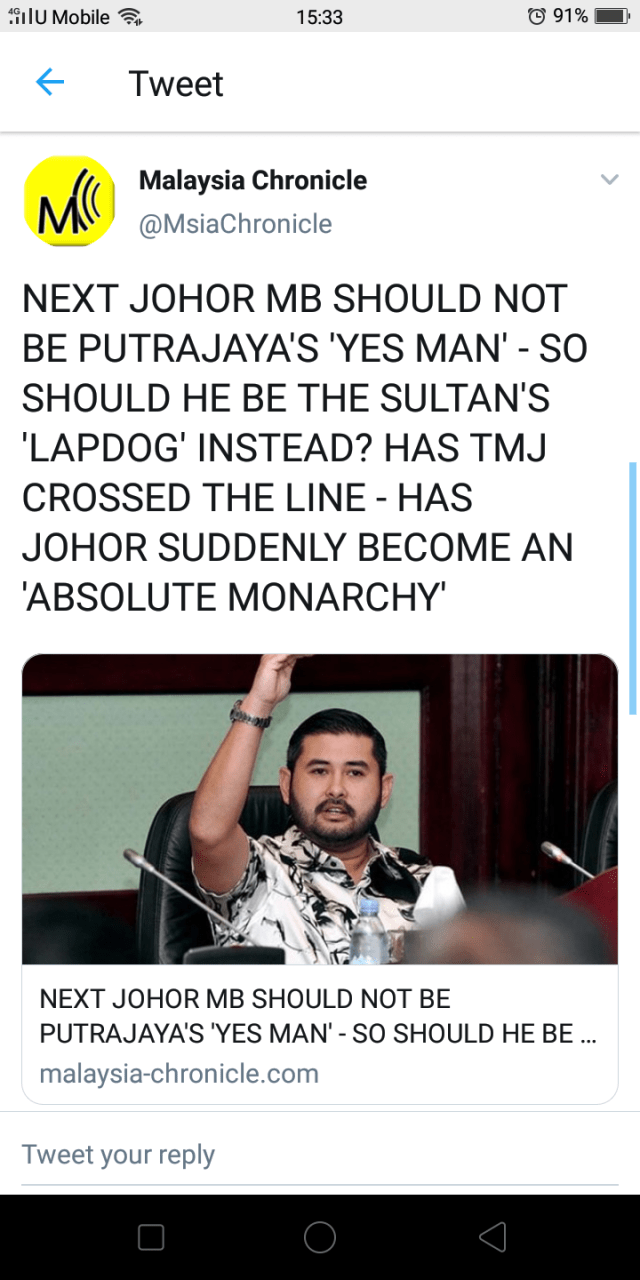
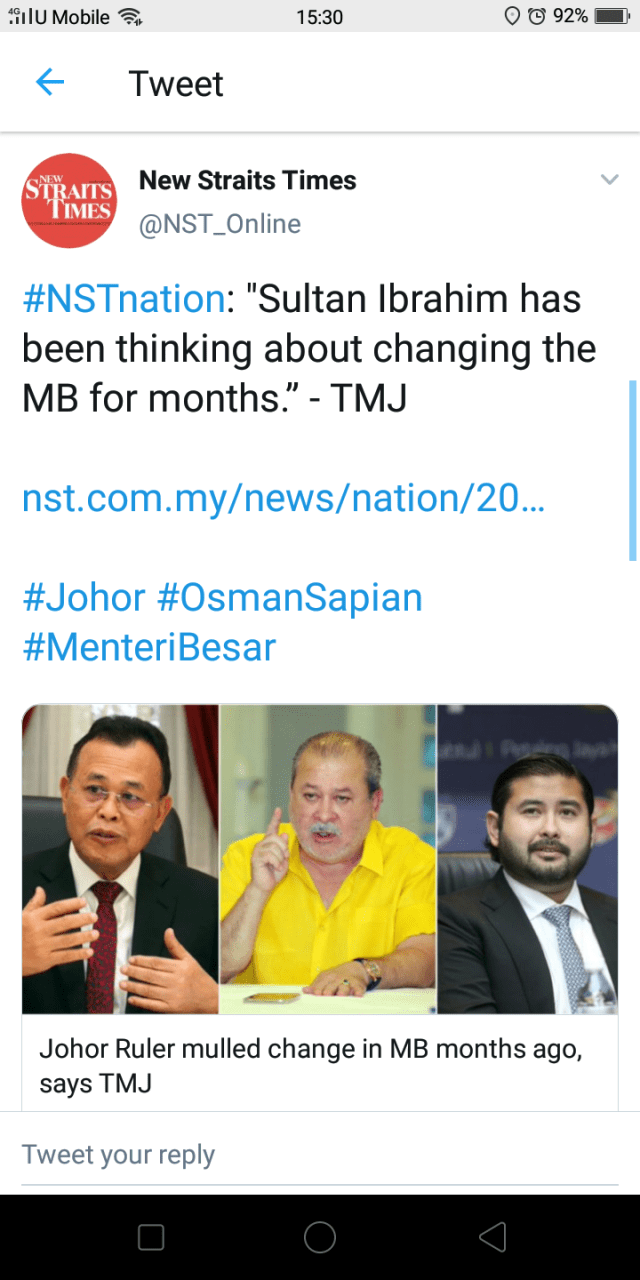
JOHOR BARU: The Johor Sultan has the absolute right to appoint a Mentri Besar as stipulated under the Undang-undang Tubuh Negeri Johor 1895, says lawyer Ahmad Solehin Abd Ghani.
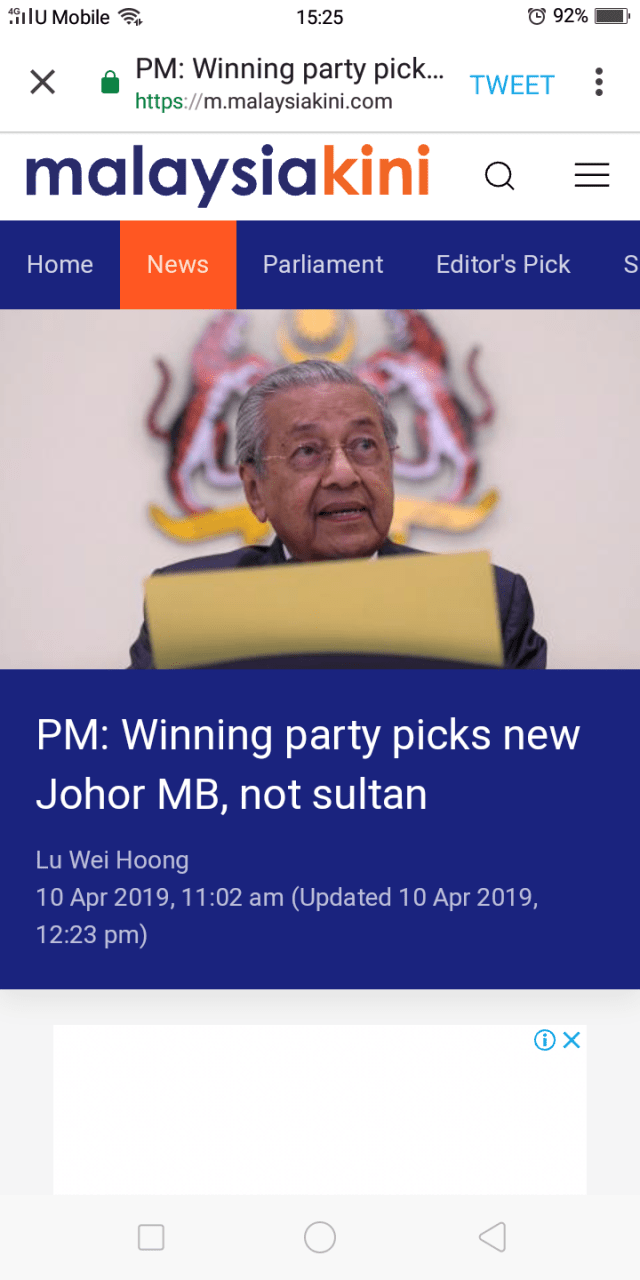
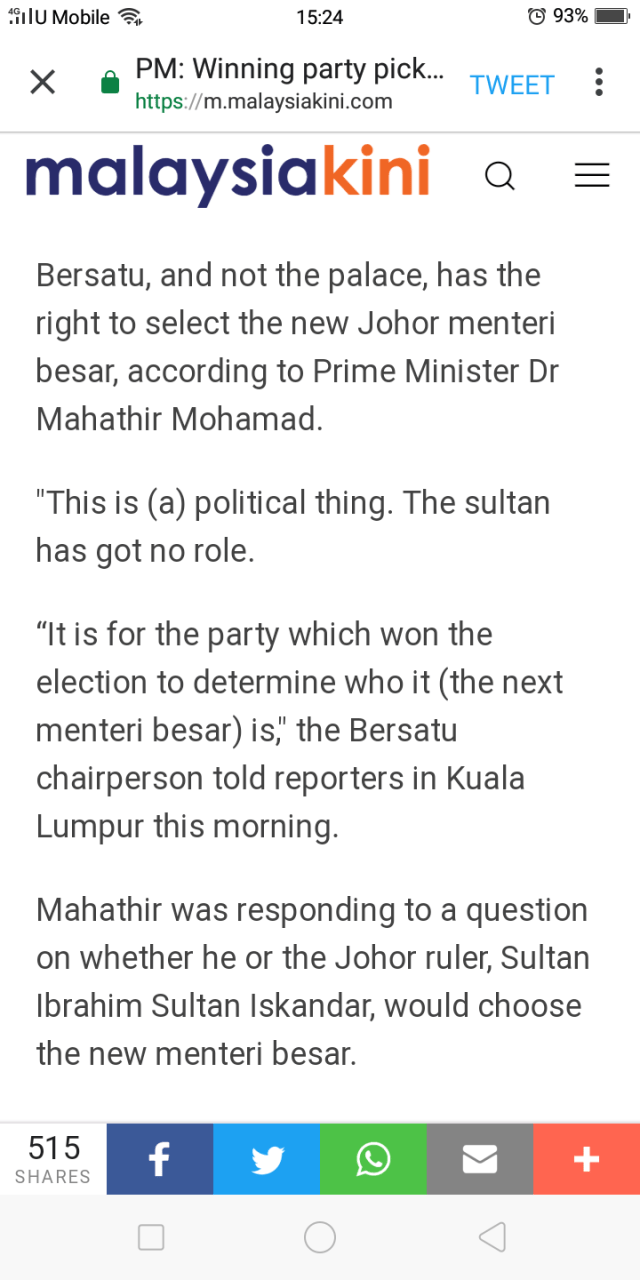
He said this in response to Prime Minister Tun Dr Mahathir Mohamad’s statement that the role of appointing the new Johor MB lay with the party that won the election, and not with the Sultan of Johor.
“Under Undang-undang Tubuh Negeri Johor, Item 3 (1), it is stated that the Sultan has the absolute right in appointing the Mentri Besar where in the issue of appointing, His Majesty does not have to act on advice from any quarters.
“However, through ‘convention’, parties that won would send several names as Mentri Besar candidate to Johor Sultan for His Majesty’s consideration where, in this matter, Pakatan Harapan should send the names,” said Solehin in his Facebook post.
His post was shared by Tunku Mahkota Johor Tunku Ismail Ibni Sultan Ibrahim via his official Facebook page here on Wednesday (April 10).
Ahmad Solehin said the Johor Ruler would review the candidates and if they were appointed, His Majesty must agree to it.
“If the candidates that are sent is not agreed to by His Majesty, then the party must send another list to Johor Sultan until an agreement is reached to appoint the candidate as the Mentri Besar.
“Tthe statement saying Sultan Johor does not have any role and right to appoint the Mentri Besar is incorrect, sidetracks and purposely done (sic) to confuse the community about the duty and role of His Majesty in the government system, especially in Johor,” he said.
Earlier in the day, Dr Mahathir had said that the Sultan of Johor had no role in appointing the new Johor mentri besar.
“The Sultan (of Johor) has got no role. The role is for the party that won the election to determine who leads.
Read more at https://www.thestar.com.my/news/nation/2019/04/10/lawyer-johor-sultan-has-absolute-right-in-appointing-mb-under-state-law/#Ic0wX4FXmU0k6EVf.99
..


https://m.malaysiakini.com/news/471646
..
..
..
..
 weehingthong