Chindian is an informal term used to refer to a person of both Chinese and Indian ancestry. There are a considerable number of Chindians in Malaysia and Singapore, where people of Chinese and Indian origin immigrated in large numbers during the 19th century.There are also a sizable number living in Hong Kong and smaller numbers in other countries with overseas Chinese and Indian diaspora, such as Jamaica, Trinidad and Tobago and Guyana in the Caribbean, as well as in Thailand, the United States, United Kingdom, Canada, New Zealand.
Francissca Peter, artiste, composer, vocal stylist and actress Bibiana Peter, manager, producer, features writer and home-maker — Chindian sisters
“WE experienced many complications growing up because of our surname. When we were small and we had enrolled in school, everyone thought we were orang putih.
“Then when they saw us they said ‘oh rojak kids lah — mixed must be Portugese Eurasian’ . The fun part is, they could never figure out what we were and we loved that mystery.
“Although our late father was of Ceylonese and Scottish descent and we were always categorised as Indians or ‘ others’, we used to wonder why we could not be identified as Chinese. After all, our mum is pure Chinese, so it can be either or.
“We are proud of our beautiful heritage and mix, but all we have ever wanted to do, was fill the race column on every form as ‘Malaysian’. Not this race or that race but MALAYSIAN!
“Sometimes people are not aware that we can understand and speak Chinese fluently and some Tamil, too, and they get a tongue lashing from us, when they are rude or insulting.
“We never want to hear a rude remark or be treated unfairly — but it has happened numerous times in our lives and even today because we are not fair enough to be considered 100 per cent Chinese and not tanned enough to be 100 per cent Indian. We still find ourselves in situations where we are excluded from a particular singing event or task/ project.
“We think our mom had it harder when she married our dad because in those days Chinese were more conservative.
” Since my dad was from mixed parentage, his family was slightly more open to mixed marriages.
“Many fans, friends and family are supportive of our mixed-parentage. Whether one is Hindu, Buddhist or Catholic, it’s just wonderful to celebrate that harmony, love, joy and respect for each other’s faith and race in a mixed marriage.”
MIXED MARRIAGES: They give rise to a ‘Malaysian’ race
LOVE is blind and marriages are made in heaven. In a multiracial country like Malaysia where people of different races live, learn and work together, it is inevitable for them to fall in love and marry someone from a different ethnic group.
Though initially, they face numerous problems from their families for wanting to marry someone from a different race and culture, they have blended well, overcame obstacles and today are living testimony of interracial and cultural bonding.
The trend of Indians marrying Chinese and vice versa has become quite common and the union has led to the emergence of a Chinese-Indian, or termed as Chindians, who have sharp facial features and fair complexion.
The Chindian family has the best of both worlds; enjoying food, culture, festivals and music from the two races.
Despite the rich cultural heritage and traditions of the union, Chindians face many challenges.
Most Chindians experience an identity crisis of being caught between two distinct and different cultures. Many of them are looked and stared at differently because of their mixed parentage.
Chindians are neither Indian nor Chinese and whatever name they are given would seem odd because they do not fit clearly into the main racial groups.
So when it comes to filling in the race column in official application forms, they are faced with a dilemma because they are of mixed parentage.
On a positive note, the Chindian identity crisis is an ideal ground for the emergence of a new race– a true Malaysian — not Indian or Chinese, but Malaysian.
The Chindian is the perfect answer to the new 1Malaysia generation where race and culture would be a thing of the past.
FINDING AN IDENTITY: The Chindian Diaries Project, focusing primarily on people of Chinese-Indian parentage (Chindians), aims to document stories from Chindians in Malaysia and Singapore. Project creator Kevin Bathman, and other Chindians who share their stories in the project’s Facebook page tell Suzanna Pillay what it’s like to be in a mixed-raced family.
Kevin Bathman, project creator
IF you don’t know anything about your family heritage or ancestors, the best way could be to start with your family album. That’s what Kevin Bathman did after participating in a weekend story-telling workshop to dig deeper on his ancestors.
“All you need is to take time out from your busy schedule and really spend quality time with your parents and grandparents. You will find stories of all kinds, from joy to heartbreaks and you may hear some beautiful stories you hadn’t known about. Who knows, you may discover things about yourself in the process,” said Kevin
“I started The Chindian Diaries project in June last year. It forced me to delve into my family history and I learnt illuminating things about my mum and grandparents. I was intrigued with my grandparents — my paternal Indian-Tamil grandfather and Chinese-Nyonya grandmother. My father used to tell me about their union and how my grandmother was disowned by her family for marrying my grandfather, a dark-skin Indian man. Because of the challenges with their own union, my paternal grandparents were open-minded with whomever my father or uncle had chosen as their partners.
“The Chindian Diaries project has not only opened up conversation with other Chindians but also given a space for the community to express themselves. From my own observations, most Chindians do experience having an identity crisis in their lives, as they have to straddle between two distinctly different cultures.
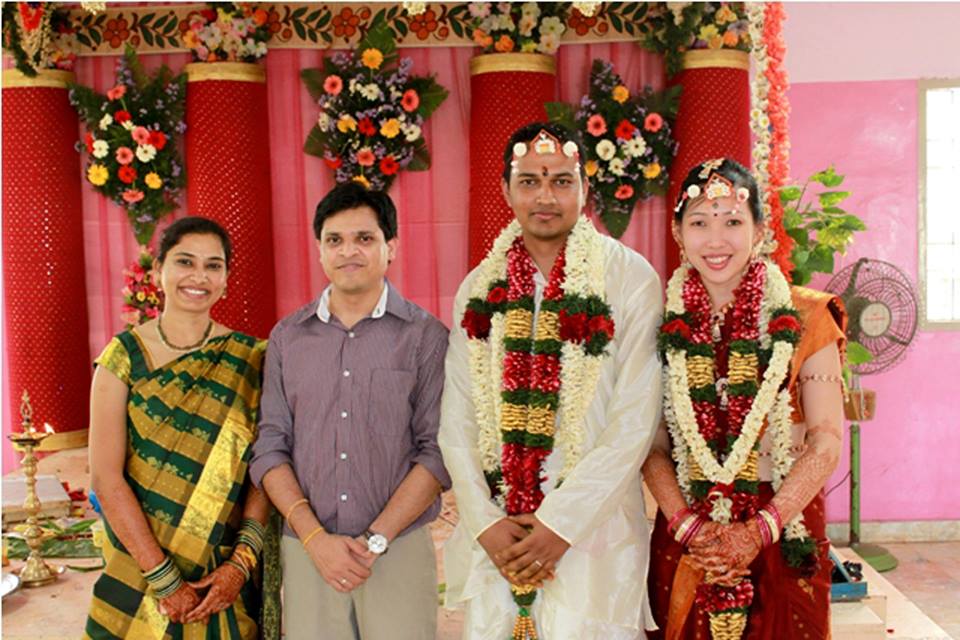
COMING BACK FOR LOVEI was born in Hyderabad but grew up in Tamil Nadu, India. My wife, Natalia is Indonesian Chinese from Batam Island, Indonesia.I met Natalia when i was I was working in Batam Island for 2 years. We were both working in the same company, and we had to interact with each other for our work. Because of the nature of our job, we had to call each other on our mobile phone. This certainly made it easier for me to ask Natalia out on a date.Sadly, Indian men don’t have a good reputation in Batam Island, as many leave their girlfriends behind and eventually marry Indian women.
After dating Natalia for 4 years, we decided that we would migrate to Australia to start a new life. At that stage, I hadn’t told my parents about our relationship yet.
Most love marriages in India are opposed by the elders. It was the same with our case as well.
One of the hardest times for me was when I had to leave Natalia to settle in Australia in the first year. It was a gruelling 10 months of being away from each other, with only emails and SMSes for contact. Till today, Natalia always thought I was never coming back for her.
My parents were apprehensive when I told them about Natalia. My sister, Ashwini, was instrumental in convincing them to meet Nataila, and only to make up their mind after meeting her. To them, they had always thought that a foreign wife would mistreat her in-laws. They were also concerned about the high divorce rates abroad and of course, like most Indian parents, what our relatives would say.
After they met Natalia and noticed how caring and respectful she was towards them, they gave us their blessings. Through the years, Natalia has learnt how to cook Indian food, and can speak a few Tamil words. Because of my Mum, Natalia is also a Tamil movie addict now.
The best part about being in an inter-racial relationship? Both our in-laws can’t communicate with each other due to language barriers, and this has saved us a lot of fuss when it came to organising the wedding. We were married in a traditional Tamil way, and that made my parents very happy.
Submitted by Balaji Jayakumar for The Chindian Diaries
—
Chinese-Indian marriages made up only 0.7 per cent of all marriages in Singapore in 2011, 0.9 per cent in 2002, and 0.4 per cent in 1972, according to the Singapore Department of Statistics.
Mixed ethnicity: Bane as kids, their edge as adults
Mr Jeremy Gopalan grew up enduring playful teasing and name calling from his peers because of his dark skin tone. -My Paper Elizabeth Kamaldin
Mon, Mar 18, 2013
My Paper
SINGAPORE – Mr Jeremy Gopalan grew up enduring playful teasing and name calling from his peers because of his dark skin tone.
His father is an Indian and his mother, a Chinese. The children of such parentage are commonly called Chindians.
Today, the 34-year-old Singaporean editor of Designare Homme magazine sees the advantages of his mixed heritage.
Being Chindian has helped him to better understand other cultures not just in Singapore but also elsewhere in the world, and better relate to people from other countries in his line of work.
This is because his mixed ethnicity “has made me more sensitive to and appreciative of the nuances in the habits and practices of different ethnic groups”, he said.
Not many people might have heard stories of their experiences, though, as Chindians are likely few and far between here.
…
Dr Edwin Nadason Thumboo, Poet and Literary Scholar
Father: An Indian who was a former primary- school teacher.
Mother: A Chinese housewife.
Dr Thumboo, 79, studied at the University of Malaya and majored in English Literature and History. He is the first Singaporean to be conferred the SEA Write Award and the Cultural Medallion in 1979 and 1980, respectively. In 2006, he was awarded the Meritorious Service Medal.
…





 weehingthong