What will happen to the US Dollar in 2023?

..

Who will be proven right?

(1) MPS chief strategist Luca Mannucci, who warns that the greenback could plunge as much as 5% against other currencies in the second half or (2) John Lynch, chief investment officer at Comerica Wealth Management, who warns that investors shouldn’t expect the dollar to weaken anytime soon?

The answer in mid August 2023: John Lynch wins.

..

The U.S. Dollar Index (USDX)

The dollar index tracks the relative value of the U.S. dollar against a basket of important world currencies. If the index is rising, it means that the dollar is strengthening against the basket – and vice-versa.
.

The U.S. Dollar Index (USDX) is a relative measure of the U.S. dollars (USD) strength against a basket of six influential currencies, including the Euro, Pound, Yen, Canadian Dollar, Swedish Korner, and Swiss Franc. The index was created in 1973, but remains useful to this day. The USDX can be used as a proxy for the health of the U.S. economy and traders can use it to speculate on the dollar’s change in value or as a hedge against currency exposure elsewhere.

..

An index value of 120 suggests that the U.S. dollar has appreciated 20% versus the basket of currencies over the time period in question. Simply put, if the USDX goes up, that means the U.S. dollar is gaining strength or value when compared to the other currencies.

Similarly, if the index is currently 80, falling 20 from its initial value, that implies that it has depreciated 20%. The appreciation and depreciation results are a factor of the time period in question.

https://www.investopedia.com/terms/u/usdx.asp

..

Italy’s MPS Capital Services Banca per le Imprese SpA, part of the banking group that includes Banca Monte dei Paschi di Siena SpA, scored top position in Bloomberg’s accuracy rankings for the first quarter of 2023.

Now, MPS chief strategist Luca Mannucci is warning that the greenback could plunge as much as 5% against other currencies in the second half. 

https://www.bloomberg.com/news/articles/2023-04-06/dollar-can-drop-a-lot-further-says-most-accurate-forecaster-mps?utm_campaign=socialflow-organic&utm_source=twitter&utm_medium=social&cmpid=socialflow-twitter-business&utm_content=business&leadSource=uverify%20wall

..

..

John Lynch, chief investment officer at Comerica Wealth Management, warns that investors shouldn’t expect the dollar to weaken anytime soon.

“We look for the greenback to nudge higher in the months ahead as Fed policy persists and global investors seek higher-yielding opportunities,” says Lynch. “This will likely place a temporary headwind on domestic and emerging market equities.”

https://www.forbes.com/advisor/investing/strong-dollar/

Wayne Duggan Contributor

Reviewed By Paul Katzeff editor

Updated: Mar 21, 2023, 3:36pm

.
The U.S. Dollar Index started 2022 in a solid uptrend. From late April through late September, the Dixie—as the index is often called—ripped to new 20-year highs. U.S. tourists traveling abroad were big beneficiaries, but the dollar’s rapid climb pressured earnings growth for U.S. companies that have overseas units.

The dollar started to cool in the final quarter of 2022 as the Federal Reserve hammered rising inflation with interest rate increases.

So far in 2023, inflation and interest rate expectations have whipsawed back and forth. The dollar has responded largely in kind.

In early March, the dollar hit its highest level since November, before investors’ concerns over stability of the U.S. banks triggered a sharp reversal in the dollar.

The USDX is now up 0.89% for 2023 as of midday March 16, and it’s up 6.6% from a year ago.
.

With the U.S. economic outlook for 2023 uncertain, the path forward for the U.S. dollar could have significant implications for inflation, international trade, technology stocks and fiat currency alternatives such as gold and Bitcoin (BTC).

.
John Lynch, chief investment officer at Comerica Wealth Management, warns that investors shouldn’t expect the dollar to weaken anytime soon.

“We look for the greenback to nudge higher in the months ahead as Fed policy persists and global investors seek higher-yielding opportunities,” says Lynch. “This will likely place a temporary headwind on domestic and emerging market equities.”

..

Posted in Uncategorized | Tagged | Leave a comment

The End of Cheap Chinese Labor

..

..

Posted in Uncategorized | Leave a comment

China’s 40-Year Economic Boom: 300 Years Cash Used Up

..

..

Posted in Uncategorized | Leave a comment

Eating Poison Fish | National Geographic

..

..

..

..

To humans, tetrodotoxin is deadly, up to 1,200 times more poisonous than cyanide. Pufferfish are the second most poisonous vertebrate in the world, after the golden poison frog. ☠️

..

Posted in Uncategorized | Tagged | Leave a comment

Macroning, a nice way to describe “kissing China’s ass”

..

..

..

..

Macron, the modern day Neville Chamberlain?

Instituted in the hope of avoiding war, appeasement was the name given to Britain’s policy in the 1930s of allowing Hitler to expand German territory unchecked. Most closely associated with British Prime Minister Neville Chamberlain, it is now widely discredited as a policy of weakness.

https://www.iwm.org.uk/history/how-britain-hoped-to-avoid-war-with-germany-in-the-1930s

..

MAOcron

..

..

Frog, known as「田鸡」(field chicken) when described in cuisine, legs are also eaten in China, but are generally restricted to Southern Chinese cuisine tradition such as Cantonese cuisine. Bullfrogs and pig frogs are farmed on a large scale in some areas of China, such as Sichuan.

https://en.wikipedia.org/wiki/Frog_legs

..

..

..

..

..

..

..

..

..

..

Posted in Uncategorized | Tagged , | Leave a comment

China has “pretty women” and “handsome men” 😂

..

..

..

..

Posted in Uncategorized | Leave a comment

Did you know that God had a Chinese Son, Hong Xiuquan, the one who died but was not resurrected?

..

Luke 24:6-7: Remember how he told you, while he was still with you in Galilee: ‘The Son of Man must be delivered over to the hands of sinners, be crucified and on the third day be raised again.

..

Hong understood that he was the second son of God, sent to save China.

..

God’s Chinese Son

The Taiping Heavenly Kingdom of Hong Xiuquan

by Jonathan D Spence (Author)

“A magnificent tapestry . . . a story that reaches beyond China into our world and time: a story of faith, hope, passion, and a fatal grandiosity.”–Washington Post Book World

Whether read for its powerful account of the largest uprising in human history, or for its foreshadowing of the terrible convulsions suffered by twentieth-century China, or for the narrative power of a great historian at his best, God’s Chinese Son must be read. At the center of this history of China’s Taiping rebellion (1845-64) stands Hong Xiuquan, a failed student of Confucian doctrine who ascends to heaven in a dream and meets his heavenly family: God, Mary, and his older brother, Jesus. He returns to earth charged to eradicate the “demon-devils,” the alien Manchu rulers of China. His success carries him and his followers to the heavenly capital at Nanjing, where they rule a large part of south China for more than a decade. Their decline and fall, wrought by internal division and the unrelenting military pressures of the Manchus and the Western powers, carry them to a hell on earth. Twenty million Chinese are left dead.

https://wwnorton.com/books/Gods-Chinese-Son/

..

..

Hong Xiuquan, born Hong Huoxiu and with the courtesy name Renkun, was a Chinese revolutionary and religious leader who led the Taiping Rebellion against the Qing dynasty. He established the Taiping Heavenly Kingdom over large portions of southern China, with himself as its “Heavenly King”.

Born: January 1, 1814, Huadu District, Guangzhou, China

Died: June 1, 1864, Nanjing, China

Children: Hong Tianguifu

Wikipedia

..

Excerpts from:

Britannica

Hong Xiuquan

Chinese prophet and rebel

Hong took the government examination for the first time in 1827 and failed to obtain even the lowest official degree, an outcome not surprising in view of the great number of candidates competing. He took the test several times, each time traveling to the provincial capital in Guangzhou (Canton), which was also the centre for trade with the West. When he failed the exam for the third time in 1837, the strain was more than he could bear. He suffered an emotional collapse. During a delirium that lasted several days, he imagined himself to be in the presence of a venerable old man with a golden beard. The old man complained that the world was overrun by evil demons, and he gave Hong a sword and seal to use in eradicating the bad spirits. Hong also believed himself to have encountered a middle-aged man who aided and instructed him in the extermination of demons.

Hong’s conversion to Christianity

When Hong recovered, he returned to his occupation as a village schoolteacher. In 1843 he took the examination for the fourth and last time, but again he failed. Shortly after this, Li Jingfang, a cousin, noticed on Hong’s bookshelves an unusual work entitled Quanshi liangyan (“Good Words for Exhorting the Age”). Written by a Chinese missionary, the work, which explained the basic elements of Christianity, had been given to Hong on his visit to Guangzhou in 1837. Apparently, Hong had briefly glanced at the book’s contents and then forgotten about it. When Li brought it to his attention, Hong reexamined the work and suddenly discovered the explanation for his visions. He realized that during his illness he had been transported to heaven. The old man he had spoken with was God, and the middle-aged man was Jesus Christ. Hong further understood that he was the second son of God, sent to save China. In reading the portions of the Bible contained in the Quanshi liangyan, Hong often translated the pronouns I, we, you, and he as referring to himself, as if the book had been written for him. He baptized himself, prayed to God, and from then on considered himself a Christian.
.

In 1847 Hong went to Guangzhou to study Christianity with the Rev. I.J. Roberts, an American missionary. The two months he spent with Roberts marked his sole formal training in the doctrines of Christianity; his writings show little understanding of concepts alien to Chinese culture.
.

After leaving Roberts, Hong joined Feng and the God Worshippers and was immediately accepted as the new leader of the group. Conditions in the countryside were deplorable, and sentiment ran high against the Qing dynasty rulers. As a result, Hong and Feng began to plot the rebellion that finally began in July 1850. Hong’s rebels expanded into neighbouring districts, and on Jan. 1, 1851, Hong’s 37th birthday, he proclaimed his new dynasty, the Taiping Tianguo (“Heavenly Kingdom of Great Peace”) and assumed the title of Tianwang, or “Heavenly King.” The Taipings pressed north through the fertile Yangtze River (Chang Jiang) valley. As the rebels passed through the countryside, whole towns and villages joined them. They grew from a ragged band of a few thousand to a fanatical but highly disciplined army of more than a million, divided into separate divisions of men and women soldiers. Men and women were considered equal by the Taipings but were allowed no contact with one another—even married couples were forbidden sexual intercourse.

Read more:

https://www.britannica.com/biography/Hong-Xiuquan

..

Excerpts from:

BBC News

Hong Xiuquan: The rebel who thought he was Jesus’s brother

  • Published 18 October 2012

By Carrie Gracie

BBC News, Shanghai

Chinese history can be read as a series of peasant rebellions. One in the 19th Century, led by a man who thought he was Christ’s brother, lasted 15 years and caused at least 10 million deaths. It taught the Communists lessons a century later, and is one reason why China’s leaders keep a close eye on rural unrest today.
.

By the end of the Taiping era at least 10 million had died, some say 20 million. Eyewitnesses described the Yangtze valley as littered with rotting corpses.

No-one knows exactly how Hong Xiuquan himself died. His decomposed body was discovered in his palace by a Qing general – an ignominious end for a challenger to empire and the opening of a terrible chapter in China’s cycle of fragmentation.

“If you look at the history of China from say the Taiping through to the death of Mao in 1976, no country had as bad a prolonged period of disasters, regime change, civil war, invasion, decline,” says Fenby.

Perhaps all of that is over. As the Communist Party prepares to hold its 18th congress, it would certainly like to think so. It has come a long way since the first congress in the Shanghai girls’ school.

But behind the mask of order and unity, China still has plenty of conflict – over land rights, corruption or injustice. There are nearly 100,000 major riots every year. No wonder Party leaders see threats everywhere and scan the horizon ready to crack down on any sign of a peasant uprising like the one which brought them to power.

Read further:

https://www.bbc.com/news/magazine-19977188

..

Posted in Uncategorized | Leave a comment

Christian Influence on the Taiping Rebellion (Heavenly Kingdom of Great Peace), 太平天國運動

..

Christian Influence on the Taiping Rebellion (Taiping Tienkuo)

I wrote an article in English, which was published in a magazine in NZ. Someone in Taiwan translated it into Chinese and published it there.

..

Posted in Uncategorized | Leave a comment

GLC CEO among 3 remanded by MACC

..

..

..

Posted in Uncategorized | Tagged | Leave a comment

Excerpts from: The dollar is dead, long live the dollar – GZERO Media

..

The dollar is dead, long live the dollar

April 05, 2023

Ian Bremmer

Every now and then, a story about some country seeking to diversify away from the US dollar kicks off a frenzy about the inevitable collapse of dollar dominance. Lately, there’s been more than a few such headlines, including:

Naturally, these have provided a fertile ground for gold bugs, crypto shills, hyperinflation truthers, techno-libertarians, anti-imperialists (read: anti-US zealots), and run-of-the-mill grifters to stoke fear about the dollar’s imminent death and its supposedly catastrophic consequences for the United States and the global economy.

But even mainstream media outlets and smart, well-meaning analysts have gotten swept into the current wave of hysteria.
.

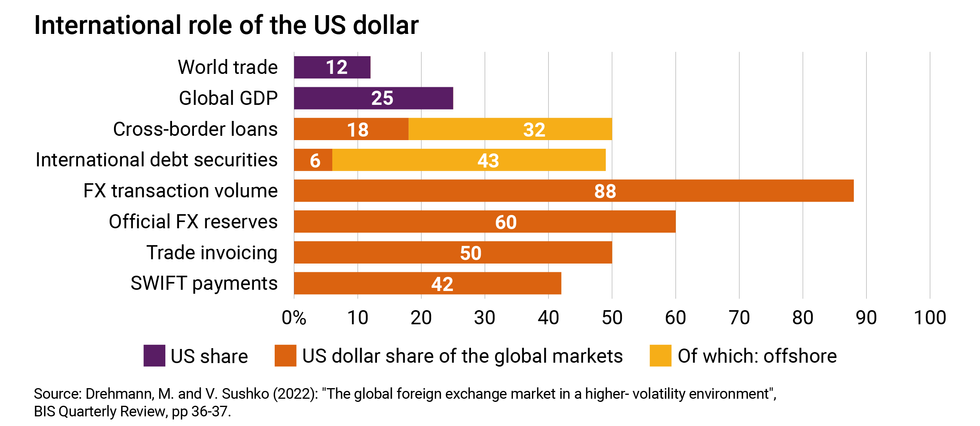
Yet rumors of the dollar’s death are greatly exaggerated. Going by most usage measures, the dollar remains incontrovertibly dominant in global trade and finance, if a little less so than at its apex.

Whereas most currencies are only used domestically or in cross-border transactions that directly involve the currency’s issuer, the dollar continues to be widely used for funding, pricing, trade invoicing and settlement, and cross-border borrowing and lending even when the US is not involved.
.

Even China, in an environment of intensifying geopolitical competition with the US and having just witnessed Washington’s weaponization of the dollar against Russia, has had no choice but to continue accumulating dollar-denominated assets.
.

The Chinese yuan, meanwhile, is not a viable alternative because of Beijing’s authoritarian and statist bent. In fact, Xi Jinping’s policy preferences – economic self-reliance, financial stability, common prosperity, and political control of the economy – run directly counter to his global-currency ambitions.

Despite its growing role in the global economy and long-standing desire to unseat the dollar, China lacks the investor protections, institutional quality, and capital market openness required to internationalize a yuan that is still not fully convertible overseas. Persistent currency and capital controls, an opaque banking system with too many non-performing loans, spotty contract enforcement, and often arbitrary and draconian regulations will all continue to undermine Beijing’s efforts to elevate the yuan.
.

The most serious threat to dollar dominance might come not from abroad (Europe, China) or from beyond (cyberspace) but from within. The United States is still the most powerful nation on earth, but it’s also the most politically divided and dysfunctional of all the major industrial democracies. The single biggest risk to the dollar’s global status is that growing inequality, tribalism, polarization, and gridlock eventually undermine trust in America’s stability and credibility.

At the end of the day, though, no matter how much the dollar seems to lose its shine, global currency status is about relative – not absolute – advantages. Without a viable challenger, it’s very unlikely that the dollar will lose its special role anytime soon – for better or worse. You can’t replace something with nothing.

https://www.gzeromedia.com/by-ian-bremmer/the-dollar-is-dead-long-live-the-dollar

..

Posted in Uncategorized | Tagged | Leave a comment