
___________________________________________________________________
EARLY MAN: THE SCIENCE AND THE ART
There is a significant difference between the science of evolution which deals with the changes that occur within a species, and the theory of evolution which is a philosophy.
Studies of Early Man were influenced by the theory of evolution. That’s why Early Man is so similar to the Apes.
You will find the following links interesting and stimulating:
Pointless, Meaningless – The Why of Evolution (http://scottthong.wordpress.com/2010/07/29/pointless-meaningless-the-why-of-evolution/)
Please Cite Me the Evidence for Evolution and Global Warming
The Sin Theory of Evolution – Reconciling Evolution, Creationism and Intelligent Design
—

THE DISCOVERY OF VARIOUS PARTS OF THE SKULL AND SKELETON OF EARLY MAN HAVE PLAYED AN INEVITABLE PART IN THE RE-CONSTRUCTION OF WHAT OUR ANCESTORS LOOK LIKE.
That is the science of Early Man.
HOWEVER, WE NEED TO SEPARATE THE SCIENCE FROM THE ART, THE FACTUAL ASPECTS AND THE DRAWINGS OF ARTISTS (GENERALLY TERMED ‘AN ARTIST’S IMPRESSION’.
—
HOMO ERECTUS
Homo erectus (meaning “upright man,” from the Latin ērĭgĕre, “to put up, set upright”) is an extinct species of hominin that lived throughout most of the Pleistocene, with the earliest first fossil evidence dating to around 1.8 million years ago and the most recent to around 143,000 years ago. The species originated in Africa and spread as far as England, Georgia, India, Sri Lanka, China and Java.
(http://en.wikipedia.org/wiki/Homo_erectus)
Homo Erectus is considered by some scientists to be an important ancestor of man.
Here is what we have of his skull and other bones.
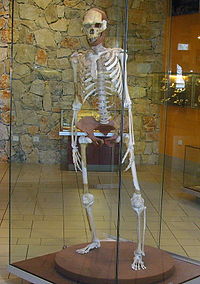
Reconstruction of a specimen from Tautavel, France
Here we have a skull of Homo Erectus.
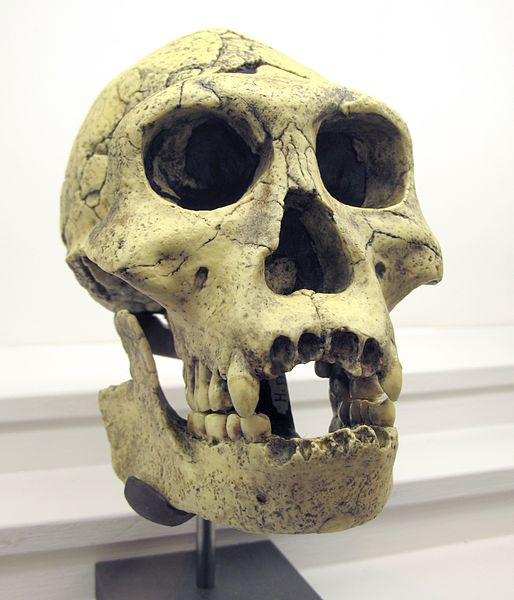
Fossil skull from Dmanisi
AFTER AN ARTIST HAH HAD A GO AT HIM, THIS WAS WHAT WE GET.

A reconstruction of Homo erectus (reconstruction shown in Westfälisches Landesmuseum, Herne, Germany, in a 2006 exhibition)
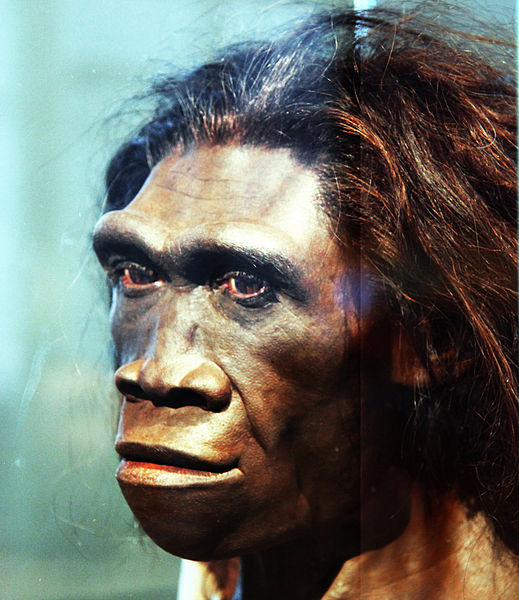
A model of the face of an adult female Homo erectus. Reconstruction by John Gurche, Smithsonian Museum of Natural History, based on KNM ER 3733 and 992
WHY DO THESE TWO, MALE AND FEMALE, LOOK SO MUCH LIKE THE GREAT APES?
Maybe the answer lies in the preconception of many scientists and artists influenced by the theory of evolution?
If you believe that man came from the apes, this certainly influences you in how you portray Early Man.
Images for evolutionary images
—
AUSTRALOPITHECUS
Australopithecus are the ape-man ancestors of humans and the first in our lineage to have walked upright as a matter of course. As many as nine different species of Australopithecus may have existed from 2-4 million years ago in Africa. The species with hefty jaws and massive faces – known as robust australopithecines – are believed by many scientists to belong in a separate genus, Paranthropus. In all australopithecines the males were up to twice the size of the females. However, even the largest male was quite short compared to modern humans, at only 150cm tall.Prehistoric life
(http://www.bbc.co.uk/nature/life/Australopithecus)
Here is Australopithecus according to an artist.
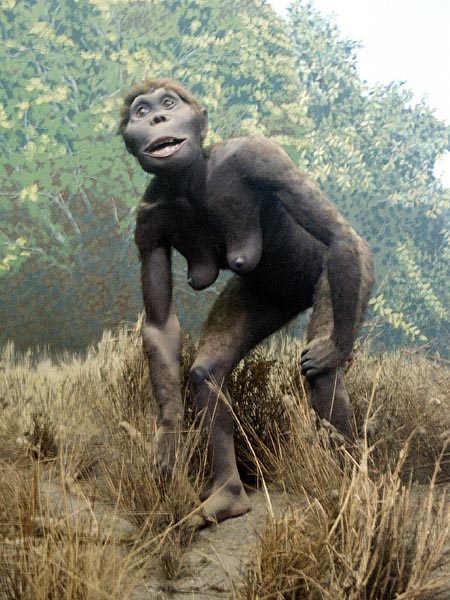
Artistic reconstruction based on fossil records brings Australopithecus Boisei to life from 1.5 million years ago
…
Today, we have the use of technology to help in the re-construction of what early man looks like. Is that helpful? Yes, but as long as there is the assumption that man came from the apes, the result will remain much the same as what artists have given us.
The video that follows betrays the same bias regarding Early Man.
Video:
———————————————————————-
 weehingthong