
________________________________________________________________
IT WILL COME, SOONER THAN LATER, SO LEARN ALL ABOUT IT…
—–
GST Malaysia: Goods and Services Tax in Malaysia – Introduction (016-intro)
—
GST Malaysia: How to Calculate Turnover for GST Registration (017-intro)
—–
Malaysian Insider
Several car parks already charging GST, says Tian Chua
BY YISWAREE PALANSAMY
October 22, 2013
Several car park operators in the Klang Valley have allegedly implemented the goods and services tax (GST) although the government has yet to officially roll it out.
Opposition Batu MP Tian Chua said that a car park operator at the Kuala Lumpur Wholesale Market in Selayang has already incorporated GST in its parking fees by adding 6% to the original amount.
“I have been informed by sources that this particular operator has implemented the GST for almost two years,” he said in a statement today.
—
“How does the government plan to stop these companies who are currently exploiting the rakyat by charging them GST?”
GST is here already!
Malaysiakini

A parking operator in Kuala Lumpur is allegedly already charging customers Goods and Services Tax (GST) for the past year, even before any official announcement by the government regarding GST implementations, PKR said today.
Batu MP Tian Chua claimed today that parking receipts show that the operator was charging a “6 percent GST” in parking charges for quite some time now.
Tian Chua also said in a statement that this operator was awarded the tender to manage the carpark by the Kuala Lumpur City Hall (DBKL).
The PKR vice-president then questioned if DBKL conducted checks on the company managing the carpark.
“If yes (checks are carried out), how was this missed?
PKR: Parking operator already charging GST
—
Malaysian Insider
Jala’s comments, Ahmad Maslan’s finance post show looming GST, says DAP
KUALA LUMPUR, May 18 — The DAP has warned Malaysians that the Goods and Services Tax (GST) could be implemented soon following Datuk Seri Idris Jala’s comments on the broad-based tax and the appointment of Umno information chief Datuk Ahmad Maslan as deputy finance minister.
Jala, who is a minister in the Prime Minister’s Department, told a forum yesterday that the GST would generate an additional revenue of between RM20 billion and RM27 billion if it was implemented at a rate of seven per cent.
“It seems that the implementation of GST is top on Najib’s list after the elections,” DAP political education director Liew Chin Tongsaid today, referring to Prime Minister Datuk Seri Najib Razak.
“Indeed, I have been alerted that the appointment of Umno propagandist Datuk Ahmad Maslan as deputy finance minister — one of the strangest of Najib’s appointments — is for him to co-ordinate propaganda for the implementation of GST,” added the Kluang MP.
Najib’s Barisan Nasional (BN) had said it would implement a broad-based tax policy if it won the May 5 general election.
Liew said last October that Najib’s Budget 2013 speech contained “coded signals” on the imminent implementation of the GST.
http://www.themalaysianinsider.com/malaysia/article/jalas-comments-ahmad-maslans-finance-post-sh
—–
Malaysiakini
Lim (Guan Eng) condemned the proposed implementation of the goods and services tax (GST), saying Pakatan would go all out in Parliament to fight the new tax.
“You give people RM500 BR1M money, and you want to get back millions by implementing the GST?” queried the DAP secretary-general.
“We will not accept this, we will go all out and fight it.
“You cannot impose this tax on the 52 percent majority (of those who voted for Pakatan) because you are a minority (government),” Lim chided.
He was referring to a statement by Minister in the Prime Minister’s Department Idris Jala who said the new tax can guarantee additional revenue of RM20 billion to RM27 billion for the government.
“I know BN has no more money, so what you have to do is stop being corrupt. Why not let us be the government and we will show you good governance,” he boasted, drawing loud cheers of approval from the Pakatan supporters.
|
60,000 defy police warning, attend ‘thanksgiving’ rally
—–
Malaysia Chronicle
Friday, 17 May 2013 18:06
With GE13 over, Idris Jala raises GST plan again
Malaysia will be able to rake in an additional income of up to RM27 billion if the proposed goods and services tax (GST) is implemented at seven per cent, similar to neighbouring Singapore.
Minister in the Prime Minister’s Department, Datuk Seri Idris Jala said the new taxation mechanism can guarantee additional revenue of RM20 billion to RM27 billion, at maturity.
“At maturity, is when, every Malaysian starts to contribute towards the GST. It must be implemented as soon as Malaysians are ready to accept the mechanism,” he added.
Speaking at the forum, “GE13 – What it means for business?” here today, Jala said education on what the GST is all about and how it benefits the country’s economy is very important, as well as for Malaysians to understand and accept the taxation mechanism moving forward.
He also said the GST will provide extra funds for the government to spend on the well-being of Malaysians, according to what was promised in the Barisan Nasional’s manifesto, before the 13th General Election.
“Even though a new tax is being introduced, Prime Minister Datuk Seri Najib Abdul Razak had committed to reducing corporate as well as personal income tax.
“This shows that the government wants a balance in every move that it makes, whether economically or politically,” said Jala, who also heads the Performance Management & Delivery Unit (Pemandu).
Meanwhile, he denied claims that the pre-election promises made by the government, will increase the debt to gross domestic product (GDP) ratio, from the current 53 per cent. He said the government is committed to maintaining its debt at well below the 55 per cent debt to GDP ceiling that it had set before this.
Bernama
http://www.malaysia-chronicle.com/index.php?option=com_k2&view=item&id=101272:with-ge13-over-id
——–
Minister defends GST as good for people
| Harakahdaily, | 14 January 2013 |
Jan 14: Second Finance minister Ahmad Husni Hanadzlah has disputed critics against the controversial Goods and Services Tax to be implemented by Barisan Nasional after the next elections, saying various parties had given positive feedback on its implementation.
But pro-government national news agency Bernama quoted Husni as saying that the government would not rush the GST implementation pending “further discussion” and after the public were fully informed.

“So that they know and understand the GST. Only then, will we implement,” he added.
_________________________________________________
THE VALUE ADDED TAX (VAT) IN THE PHILIPPINES
Value Added Taxes (VAT)
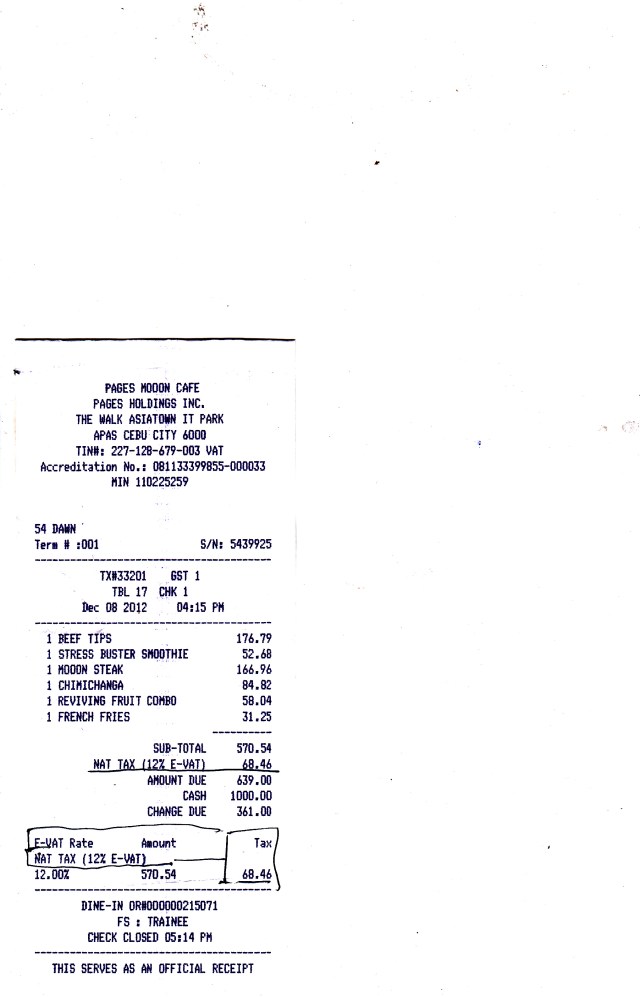
In the Philippines, the rate of VAT is at 12%. With some additional VAT:
- Cockpits and Cabarets: 18%
- Jai-Jalai and racetracks: 30%
And with some exceptions:
- Small Businesses: 10%
- Not VAT-registered businesses: 3-5%
WE WENT TO CEBU CITY ON CEBU ISLAND AND HAD A MEAL, AND YOU CAN SEE FOR YOURSELF THE 12% VAT (GST) WE PAID.
____________________________________________________________________
GST Malaysia: Goods and Services Tax in Malaysia – Introduction (016-intro)
GST Malaysia: How to Calculate Turnover for GST Registration (017-intro)
________________________________________________________________
GST is expected to give the federal government a wider scope to collect taxes as it is based on consumption rather than income, thus spreading the tax burden more evenly.
The Najib administration has said that the implementation of the GST will not happen until the public had been sufficiently educated on the new tax system and many observers expect GST to be introduced after the general election.
Malaysian Insider
Malaysia needs to step up tax and subsidy reforms, says IMF chief
KUALA LUMPUR, Nov 14 — Malaysia needs a faster overhaul of its tax and subsidy regimes to sustain economic growth, said Christine Lagarde, chief of the International Monetary Fund (IMF).
Lagarde said in an interview with The Edge that the Malaysian government not only needed to broaden its revenue base by introducing the goods and services tax (GST) but also needed to confine subsidies to the truly needy as well as eliminate tax incentives that were unproductive.
“The allocation of public resources could also be improved by the streamlining of untargeted subsidies and wasteful tax incentives and replacing them with targeted assistance to the truly needy,” she told The Edge.
Malaysia’s finances are regarded as among the weakest in Asia due to its high debt-to-revenue ratio and reliance on petroleum to finance its budget.
Approximately one-third of federal government income is from oil and gas alone, and only one-third from taxes paid by companies and individuals.
A paltry 1.7 million out of 12.8 million working adults paid income tax last year and only 130,000 companies out of 700,000 paid taxes.
The amount of taxes from individuals amounted to just RM14 billion last year while the total from companies came up to about RM40 billion.
Oil and gas, meanwhile, contributed about RM60 billion to government coffers.
Malaysia needs to step up tax and subsidy reforms, says IMF chief
———————————————————————-
Free Malaysia Today
GST for oranges, but not lobsters
A senior government officer admits to some unavoidable ‘limitations’ in the impending Goods & Services Tax (GST) but insists that it is a good for the country.
KUALA LUMPUR: Luxury food items such as abalone, lobsters, and oysters will be exempted from the Goods & Services Tax( GST) while common fruits such as oranges will be taxed.
The above example is said to be “illogical” and “unfair”, given that the government’s intention for the proposed GST is to only make basic necessities tax free.
Customs deputy director GST special unit Wan Leng Whatt explained that such incidents are due to unavoidable “limitations”.
“These issues are difficult to answer and there are many more of such examples. Yes, it’s true that lobsters and even abalones and oysters are zero rated. Fruits are generally standard rated,” he said during a recent talk on GST.
Wan said while the government generally wanted to make all basic food “zero rated”, problems arose when certain items do not have a properly defined “code”.
“We wanted to zero rate basic food. We want people to be able to afford fish and prawn but at the same time we don’t have codings for lobsters, abalone, oysters [to differentiate item types]. These were simply the limitations,” he said.
However, other gourmet food such as shark’s fin and dried mushrooms are taxed as those items had codings, he noted.
As for fruits, Wan explained that the government initially intended to make local fruits — such as papaya, rambutams and mangosteen — zero rated as well but later decided against it.
“But the low income group doesn’t really eat these fruits. So now, generally all fruits will be taxed under GST.
“And when we talk about low income group, many of them actually have their own bananas, [so] they eat their own bananas, [and] they don’t have to buy. However, we pity those who are urban poor, they will be burdened in these aspects, I acknowledge that,” he added.
GST for oranges, but not lobsters
———————————————————————
The GST Malaysia
From Wikipedia, the free encyclopedia
A goods and services tax in Malaysia (GST), a value added tax was scheduled to be implemented by the government during the third quarter of 2011.
Its purpose is to replace the sales and service tax which has been used in the country for several decades. The government is seeking additional revenue to offset its budget deficit and reduce its dependence on revenue from Petronas, Malaysia’s state-owned oil company. The four-percent tax will replace a sales-and-service tax of between five and ten percent.
The Goods and Services Tax Bill 2009 was tabled for its first reading at the Dewan Rakyat (the lower house of the Malaysian parliament) on 16 December 2009. It was delayed amid mounting criticism. The government responded by asserting that the tax on oil income will not be sustainable in the future. National Consumer Complaints Centre head Muhammad Sha’ani Abdullah has said, “The government should create more awareness on what the GST is. The public cannot be blamed for their lack of understanding, and thus, their fears”.
Sha’ani says that the GST will improve accounting, reduce tax fraud, and facilitate enforcement of the upcoming Anti-Profiteering Act. Muslim Consumer Association of Malaysia leader Datuk Dr. Ma’amor Osman said the GST could help end dishonest business practices, but expressed concern about how the tax would be applied to medical products and services. A group leading the campaign against the GST, Protes (which objects to the GST because of concerns about its effects on low-income Malaysians), cancelled a planned protest but has stated that they will continue to agitate against the legislation.
———————————————————————-

What is GST?
Basic GST model in Malaysia
-
GST which is also known as VAT or the value added tax in many countries is a multi-stage consumption tax on goods and services
-
GST is levied on the supply of goods and services at each stage of the supply chain from the supplier up to the retail stage of the distribution. Even though GST is imposed at each level of the supply chain, the tax element does not become part of the cost of the product because GST paid on the business inputs is claimable. Hence, it does not matter how many stages where a particular good and service goes through the supply chain because the input tax incurred at the previous stage is always deducted by the businesses at the next step in the supply chain.
-
GST is a broad based consumption tax covering all sectors of the economy i.e all goods and services made in Malaysia including imports except specific goods and services which are categorized under zero rated supply and exempt supply orders as determined by the Minister of Finance and published in the Gazette.
-
The basic fundamental of GST is its self-policing features which allow the businesses to claim their Input tax credit by way of automatic deduction in their accounting system. This eases the administrative procedures on the part of businesses and the Government. Thus, the Government’s delivery system will be further enhanced.
Scope and charge
-
GST shall be levied and charged on the taxable supply of goods and services made in the course or furtherance of business in Malaysia by a taxable person. GST is also charged on the importation of goods and services.
-
A taxable supply is a supply which is standard rated or zero rated. Exempt and out of scope supplies are not taxable supplies.
-
GST is to be levied and charged at the proposed rate of 4% on the value of the supply.
-
GST can only to be levied and charged if the business is registered under GST. A business is not liable to be registered if its annual turnover of taxable supplies does not reach the prescribed threshold. Therefore, such businesses cannot charge and collect GST on the supply of goods and services made to their customers. Nevertheless, businesses can apply to be registered voluntarily.
Types of supply
-
Standard-rated supplies
Standard-rated supplies are taxable supplies of goods and services which are subject to a proposed rate of 4%. A taxable person who is registered under GST has to collect GST on the supply and is eligible to claim input tax credit on his business inputs in making taxable supplies.
-
Zero-rated supplies
Zero-rated supplies are taxable supplies of goods and services which are subject to GST at zero percent rate. In this respect, businesses do not collect any GST on their supplies but are entitled to claim credit on inputs used in the course or furtherance of the business. To view the full list of zero rated supplies, (click here)
-
Exempt supplies
Exempt supplies are supplies of goods or services which are not subject to GST. In this context, businesses do not collect any GST on their supplies and are not entitled to claim credit on his business inputs. To view the full list of exempt supplies, (click here)
-
Supplies not within the scope of GST
Supplies which do not fall within the charging provision of the GST Act include non-business transactions, sale of goods from a place outside Malaysia to another place outside Malaysia as well as services provided by the Government sector.
For more details:
| ABOUT GST | |
| >> | History |
| >> | What is GST? |
| >> | Why GST? |
| >> | How does GST work? |
| >> | What you need to do |
Click on:
GST Portal Main Page
www.gst.customs.gov.my – Cached
———————————————————————-
 weehingthong
Reblogged this on weehingthong.
Pingback: The GST (Goods and Services Tax) Malaysia: Arriving SOON! | weehingthong
Pingback: April Fool! But we’re the fools: GST begins on 1 April 2014 | weehingthong
Pingback: Anti GST Rally, Dataran Merdeka, 1 May 2014: 2pm | weehingthong
Pingback: Malaysia: Trending Hashtags of 2015 | weehingthong