
—
…
25 July 2018
https://twitter.com/amirhimself/status/1022109019199102976
…
19 Jan 2017
Local grads only as good as Danish high school dropouts
SUBANG JAYA: Malaysian graduates have been equated to Danish high school dropouts, despite the government having invested sufficient funds in education and impressive teaching tools in schools.
Harvard professor Lant Pritchett said he had carried out research in Indonesia and found the Indonesian situation to be similar to Malaysia’s.
“Research was done on graduates in Indonesia on literacy, creative thinking and on other aspects and the results were the same as junior high school dropouts in Denmark. The same features appear in Malaysia.
“The reason is because students leave primary school without mastering the subjects and the same with secondary (school students). By the time they reach the tertiary (level), they are left far behind. There is no deep understanding of the materials. Instead, it is rote memorisation, applying theory and regurgitating it during exams,” he told FMT.
Pritchett was in Malaysia for the Asia Public Policy Forum 2016 co-hosted by Harvard Kennedy School and the Jeffrey Cheah Institute of Southeast Asia here.
He said the real measure of education should be mastery of the subject with practical application, and which was not confined to rote memorisation of the subject.
…
2016
Wow! They are so proud of this achievement!
Still, something to boast of is better than being laughed at all the time…
Try not to look at Singapore.
QS World University Rankings® 2015/16
|
12 94.2
|
 |
||
|
13 93.9
|


|
146 62.1
|
|
289 43.4
|
|
303 41.9
|
|
312 41.3
|
|
331 39.7
|
..
 Idris Jusoh
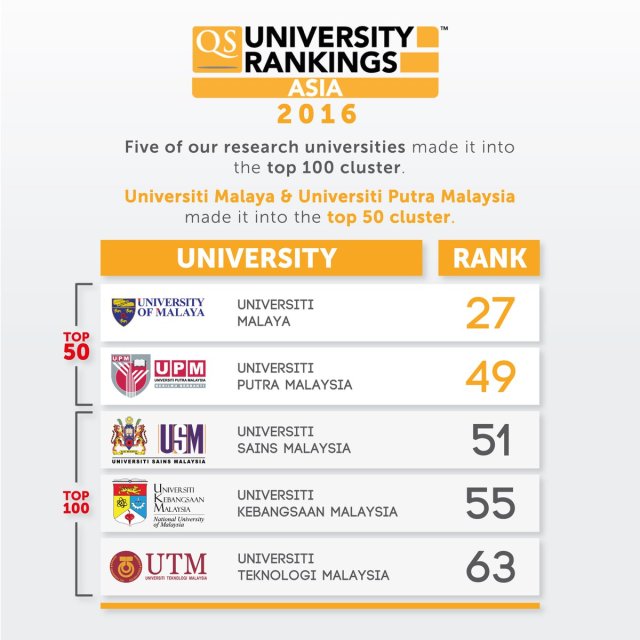
 5 of our Research Universities made it into the top 100 cluster in 2016. UM & UPM made it into the top 50! #Malaysia
…
Five of our Research Universities made it into the top 100 cluster in 2016. University of Malaya & Universiti… http://fb.me/4oS8fYdok
—
24 January 2016
Parents tell M’sian edu ministry to stop treating their kids like lab rats
“Why can’t our education system be more like the system in Singapore? They don’t just simply change their syllabus,” said Raju, 40, who is based in Johor Baru.
Fed up M’sian parents ask “Why can’t our education system be more like Singapore?” http://bit.ly/1nrX8MH

…
KUALA LUMPUR — The Education Ministry’s plan to change the format of the Standard Six Ujian Pencapaian Sekolah Rendah (UPSR) exam to 40 per cent school-based assessments and 60 per cent exams, similar to the Form Three Assessment (PT3), has drawn the ire of parents.
Those approached by The Malaysian Insider said they did not want their children to be treated like lab rats to test new exam formats, following the recent announcement by Education Minister Mahdzir Khalid.
An IT supervisor, who gave his name as Raju, said the ministry needed to think of the relevance of its decisions.
“My kid is not a lab rat, told to do this and then do that. My kid is becoming a victim.
“Why can’t our education system be more like the system in Singapore? They don’t just simply change their syllabus,” said Raju, 40, who is based in Johor Baru.
“To change it to be like the PT3, the ministry is also going to burden teachers, who have to assess their pupils’ work and key in the marks at slow Internet speeds.
“(The ministry) should do something more reasonable to boost the performance of pupils,” he added.
Restaurant manager Roney Ratuhaqie Kamas Masud, 43, disapproved of frequent changes in the format for public school exams, saying it confused his child.
…
“The ministry should try without changing the format. This is because the children will get confused and parents will go all out to dominate the situation… that always happen with parents.”
Roney said the syllabus was more difficult than before and pupils were burdened with all sorts of assignments.
…
National Union of the Teaching Profession (NUTP) president Hashim Adnan has said Mr Mahdzir’s suggestion to implement the new format would only invite problems, because teachers and students were still familiarising themselves with the PT3 concept introduced in 2014.
—
29 October 2015
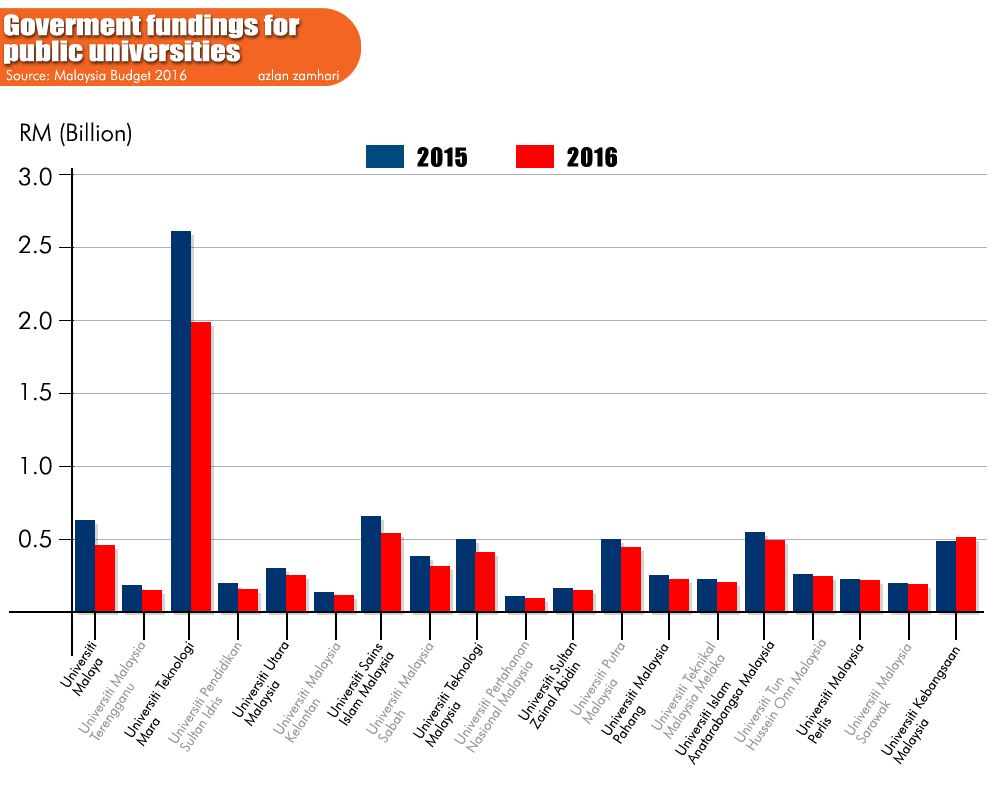
#Infographics Allocation for universities – budget 2015 & 2016 comparison: http://malaysiakini.com
—
27 October 2015
HOW TO BE WORLD CLASS?
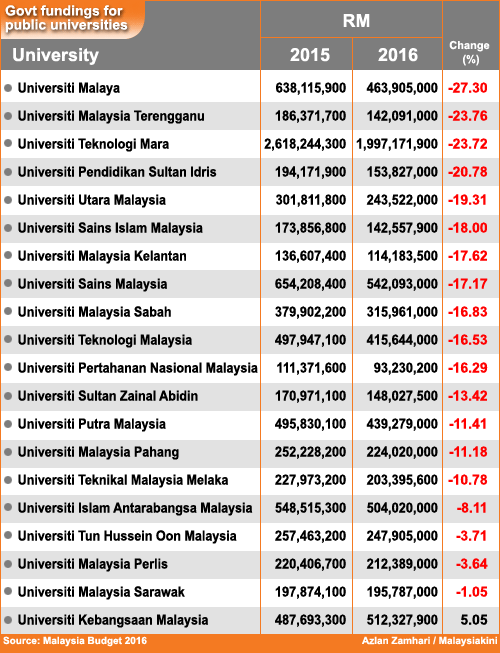
#Budget2016 #Infographics How much will be given to public universities next year? http://malaysiakini.com
—
19 October 2015
DISPLAYING TO ALL AND SUNDRY THE EXTENT OF THE FAILURE OF OUR ‘WORLD CLASS INSTITUTIONS’…
Perbandingan ranking Universiti2 Awam Malaysia & dunia. Kita perlu bangga dan juga terus berusaha #SoaringUpwards

—
11 June 2015
Let’s not use selective stats to fudge the truth
.@zairilkj: Let’s not use selective stats to fudge the truth http://www.malaysiakini.com/news/301459 #UniversityRankings

MP SPEAKS The results of the latest Times Higher Education (THE) Asia University Rankings reveal a lot.
…
Recently, Second Education Minister Idris Jusoh repeated his grand claim that Malaysian universities are on-track to becoming “world-class” institutions. Unfortunately, such a claim is nothing but a pipe dream when it is only backed up by selective statistics.
For example, the minister points to our progress in the QS rankings as proof that our universities are making great strides.
According to the rival QS University Rankings: Asia 2015 report, Universiti Malaya (UM) was placed 29th while Universiti Sains Malaysia improved to 49th in Asia. In the QS World University Rankings, UM managed a respectable 151st position.
The QS results are indeed a positive achievement, but the only way to prove the success of our universities in an objective manner, and without the bias inherent in any single methodology, is to compare the results with other international assessments.
Unfortunately, our universities don’t seem to be consistent in this aspect. For example, the latest Best Global Universities Ranking by Thomson Reuters placed UM at 423rd in the world, while the Center for World University Rankings had the same university at 492nd place.
This underperformance is actually consistent with the fact that UM has failed to make it into the top 400 of the THE World University Rankings since 2010, before it pulled out of the survey.
Therefore, the use of the QS rankings alone as proof of our “progress” is nothing more than cherry-picking.
…
ZAIRIL KHIR JOHARI is the MP for Bukit Bendera and DAP assistant national publicity secretary.
http://www.malaysiakini.com/news/301459
—
Malaysian varsities fail to make the cut among Asia’s top 100
Despite the gains Malaysia has made in the QS rankings, universities in Malaysia again failed to feature in Times Higher Education’s ranking released today
June 11, 2015
KUALA LUMPUR — Malaysian universities failed to make the cut for the Times Higher Education (THE) Asia University Rankings 2015 for the fourth year in a row.
The failure is all the more pronounced for Southeast Asia’s third largest economy as Singapore succeeded in getting two national universities into the top 10 and even Thailand climbed into the top 100.
The list is topped by Japan’s University of Tokyo followed by the National University of Singapore (NUS) in second place while the island republic’s Nanyang Technological University (NTU) landed the 10th spot of THE’s top universities in Asia.
Northern neighbour, Thailand also secured two spots in the best 100 list with King Mongkut’s University of Technology Thonburi and Mahidol University at 55 and 91 respectively.
http://www.todayonline.com/world/asia/malaysian-varsities-fail-make-cut-among-asias-top-100
—
10 June 21015
The QS Asian University Rankings of the 300 Top universities in Asia.
Malay Mail Online
UM breaks into Asia’s top-30 universities as Singapore’s NUS stays No. 1
KUALA LUMPUR, June 10 ― The University of Malaya (UM) has emerged as the only Malaysian university to break into the top-30 of the QS University Rankings: Asia 2015, as two Singaporean institutions maintained leading positions in the annual rankings’ top-10 list.
UM achieved an overall score of 84.8, bumping up the university to 29th place and three positions better than its 32nd place finish last year. The country’s oldest university was 20 spots ahead of Universiti Sains Malaysia (USM), which registered an overall score of 69.4 to enter the rankings at 49th place, up from 57th place a year earlier.
USM managed to break into the top-50 through improvements in a wide range of areas that include academic reputation, faculty/student ratio, research productivity and its international faculty. Universiti Kebangsaan Malaysia (UKM) stayed in 56th place, while Universiti Teknologi Malaysia (UTM) rose five places to 61st and Universiti Putra Malaysia leapt 10 spots to finish in 66th.
…
The National University of Singapore, meanwhile, maintained its position as the number one institution in Asia while the Nanyang Technological University added another feather to the island nation’s hat by rising three spots to fourth this year.
…
 Saifuddin Abdullah
 “@Johan_Jaaffar: 5 local universities among top 100. Slowly, steadily, surely! Bravo! @idrisjusoh @PKamalanathan ” RT

—
UM in top 30 QS Asia rankings http://www.nst.com.my/node/87696 @unimalaya @TopUnis #nst170 #nsteducation
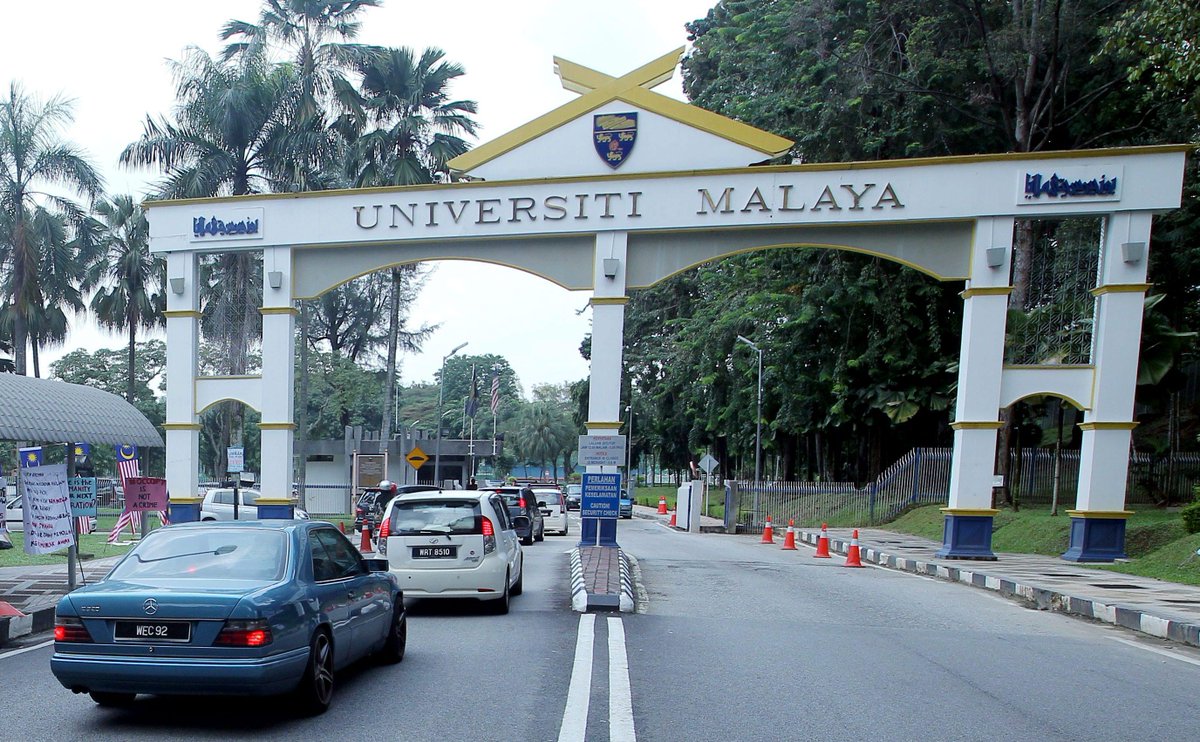
…KUALA LUMPUR: Four Malaysian public universities, all research universities, have improved on their rankings in the 2015 QS Asian University Rankings as compared to last year.
Second Education Minister Datuk Seri Idris Jusoh said Universiti Malaya rose to 29th place from 32 last year while Universiti Sains Malaysia to 49 from 57.
He said Universiti Teknologi Malaysia was ranked 61st from its former position of 66, Universiti Putra Malaysia (76 to 66), while Universiti Kebangsaan Malaysia remained in 56th position.
Singapore was ranked first, followed by Hong Kong and South Korea while Japan and Taiwan were joint-fourth, in an Asian dominance of the top five spots in the study.
Malaysia? 52nd out of 76!
Malay Mail Online
As Singapore tops world, Malaysia ranks low on latest OECD maths and science scores
KUALA LUMPUR, May 13 ― The mathematics and science proficiency among Malaysia’s 15-year-olds is comparable to counterparts in poorer and less developed countries, according to a new study by the Organisation for Economic Co-operation and Development (OECD).
The study, based on students’ test scores in the two subjects, ranked Malaysia 52nd out of 76 countries, several rungs behind Thailand (47), Kazakhstan (49) and Iran (51). …
Last March, Deputy Prime Minister and Education Minister Tan Sri Muhyiddin Yassin admitted that Malaysia’s education system is “not that good”, but stressed that it will take at least several years before any improvements will yield results.
His statement was a departure from Putrajaya’s repeated declarations that Malaysian universities were among the best in the world despite consistently falling out of global rankings.
—
If we are world class, as claimed by Education Minister II Idris Jusoh, why are so many of our graduates from local public universities unemployed?
Free Malaysia Today
400,000 unemployed in M’sia, mostly graduates
Minister says 161,000 graduates or 8.8 per cent of youths, aged between 20 and 24 years, had yet to find a job.
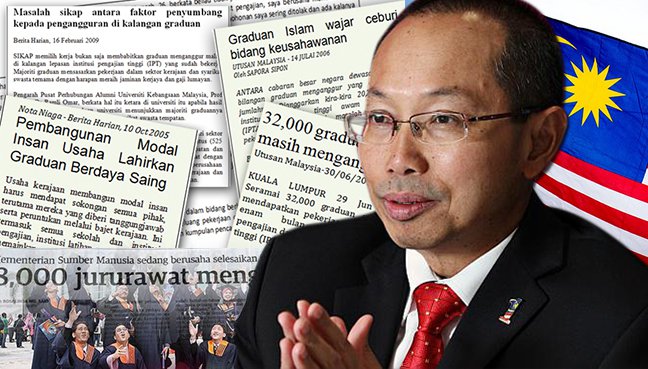
PUTRAJAYA: Graduates who have completed their studies in six months are among the current 400,000 unemployed individuals in the country, said Minister in the Prime Minister’s Department Abdul Wahid Omar.
He said according to statistics, 161,000 graduates or 8.8 per cent of youths, aged between 20 and 24 years, had yet to find a job. Despite the launching of several programmes by the government to increase jobs such as Jobs Malaysia and the 1Malaysia Training Scheme the employment rate remains low.
…
Therefore, he said, the government was encouraging the involvement of private companies to actively open up employment opportunities and provide industrial training to the target group. “The government will make sure they have stable jobs to support economic growth in a more inclusive way. That is why the government welcomes assistance and the involvement of private companies,” he said.
Since 2011, more than 19,000 graduates have received training and have been placed in companies, which included Malaysia Airlines (MAS), Permodalan Nasional Berhad (PNB), Gamuda Group Bhd, Sime Darby Bhd (Sime Darby), Celcom Axiata Bhd (Celcom) and Malaysia Airports Holdings Bhd. (MAHB).
– BERNAMA
—
MALAYSIA’S TERTIARY EDUCATION: WORLD CLASS? Really?
Education Minister II Idris Jusoh has said that Malaysia’s higher education system is now on par with developed nations like the United Kingdom, Germany and Australia in view of the fact that the 135,000 foreign students here make up 10 per cent of all students in local institutions of higher learning.
Read what Senator S. Ramakrishnan has to say:
1. Foreign students are not in Malaysia because of its education standards. “It is the third world countries’ students who come here to study.”
2. “There are, in fact, also more Middle East students than local non-Malays in local public universities.” (This means that Middle East students in government universities number more than Chinese and Indian students combined!) Many Middle Eastern students get scholarships from the Malaysian government.
3. Malaysia is a stepping stone for Middle Easterners before they migrate to third countries, he said. “Malaysia is also relatively cheaper for those among them who want a degree. Many are here to learn English before they go back.”
4. He said that a lawyer friend told him that nearly 30 per cent of African students are languishing in Malaysian prisons for various offences including violating immigration laws, drug dealing or other illegal activities. “The Malaysian government spends millions keeping these students in prison. It’s a big drain on the government coffers.”
5. Many Chinese students are enrolled in local colleges that have twinning programmes with foreign universities. Malaysia appears to be a stepping stone for these students to get foreign degrees or migrate to a third country. “Students from China choose Malaysia as they feel at home here with the local Chinese culture and food is affordable,” he said. “They are not here to get a Malaysian education.”
—
Cannabis use ‘shrinks and rewires’ the brain http://fw.to/yNwsmjM (Pic: Getty)

The loss of brain volume is balanced to some extent by more connections between neurons, study finds
For more: http://www.telegraph.co.uk/health/11221518/Cannabis-use-shrinks-and-rewires-the-brain.html
—
Perdana University Graduate School of Medicine associate professor Datuk Dr Andrew Mohanraj said he had seen a “shocking” increase in young patients seeking treatment for marijuana-related issues.

Marijuana easily available at local universities: http://bit.ly/11cTtHC

PETALING JAYA: Marijuana dealers based in several colleges and universities are taking the term “higher education” to a whole new level. They have created a peer-to-peer distribution system that is making the substance shockingly accessible to students. The Star’s team discovered this when reporters from the R.AGE section posed as students at several campuses in the Klang Valley.

They were able to get in touch with a 20-year-old marijuana dealer. “I get my stock from a supplier outside of my campus and I basically help others buy it for them,” said the dealer, a business degree student who supplies marijuana to colleges and universities around the Klang Valley at a starting price of RM50. …
Another student, who said he regularly smoked marijuana in his university’s carpark, claimed most major colleges and universities in Malaysia had at least one such dealer. … Checks with four other colleges also turned up similar stories, with many saying the drug was easily available.
…
The situation is the same in Penang, said a real estate agent who recently graduated from college. She said the marijuana there was fresher as it was closer to Thailand. “It’s very common for dealers in Penang to have direct contact with suppliers in Thailand,” she said.
—
Star
November 11, 2014
Marijuana madness
by JC Lam HE’S not quite the Heisenberg of Malaysia just yet, but business degree student Sadhi (not his real name) is – for all intents and purposes – a drug dealer at the age of 20.
Sadhi provides marijuana to college and university students around the Klang Valley. All you need to do is call him, place your order (starting from RM50) and the weed could be delivered to you on the day itself.
And how exactly do you get his number? Easy. All we had to do was go to a university in Petaling Jaya, pose as students, and ask random people. Almost everyone said they either smoked weed, or knew others who did.
By the third person we spoke to, we got Sadhi’s number. But Sadhi is only a small part of a marijuana distribution system that has seen the drug become shockingly accessible to college students in Malaysia.
Most marijuana users and small-time dealers we spoke to talk about a “peer-to-peer” system, where one or two daring students – who usually start out as recreational users – buy the drug in bulk and distribute it to their college/university-mates.
http://rage.com.my/marijuana-madness/ ————————————————————————————————————–

